)
)
Background
Autosomal Dominant Polycystic Kidney Disease (ADPKD) is a common cause of kidney failure. It is an inherited condition that can be passed on from a parent to their child. ADPKD causes fluid filled sacs called cysts to form inside the kidneys. These cysts start growing in childhood and continue to get bigger throughout a person’s life. The cysts slowly take over space in the kidneys. This stops the kidneys filtering waste and extra fluid from the blood. By their late 50s, more than 7 in every 10 people with ADPKD get kidney failure that requires dialysis or a kidney transplant.
Only one licensed treatment (tolvaptan) is currently available. However, it is not suitable for all patients and can cause troublesome side effects. There is an urgent need to find better treatment options to slow the rate of cyst growth and related kidney damage.
Encouragingly, a number of small studies have found that a well-known drug called metformin could help slow cyst growth in ADPKD patients. However, a larger trial is needed to find out whether this is the case which is why IMPEDE-PKD is taking place.
IMPEDE-PKD will enrol people with ADPKD from across the world including the United Kingdom (UK), Australia, New Zealand, Europe, Asia, and North America.
The aim of the study is to find out whether taking a metformin tablet(s) daily compared to a placebo “dummy” tablet(s) slows the rate of cyst growth and kidney function decline in people with ADPKD.
Who can participate?
Patients aged 18 – 70 years old with a diagnosis of ADPKD, at chronic kidney disease stage 2/3.
People taking tolvaptan may be able to take part, as long as they have been taking tolvaptan for the past 6 months and at the same stable dose for the past 3 months.
What does the study involve?
Participation takes place over two phases: A 12 week run-in phase and a 2 year treatment phase.
13 study reviews - Some at the hospital and the rest by phone call.
Study assessments include: Physical examination blood tests, urine tests, questionnaires.
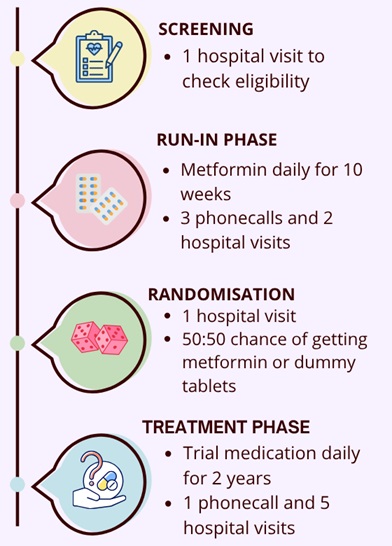
What are the possible benefits and risks of participating?
Benefits
There is no guarantee that the study will help participants personally, but the information we get from this study will improve our ability to treat patients with ADPKD in the future.
Risks
You may not receive metformin in the treatment phase, you may receive the placebo “dummy” drug, however you will still continue to receive your standard treatment for ADPKD.
Participants will be required to complete 13 study visits throughout the trial, 9 will take place at in person clinic visits and 4 will take place over the phone . Where possible, the research teams will try to coincide these reviews with your routine clinic appointments.
Blood tests may cause some discomfort, bruising, and/or bleeding.
Some participants may experience side effects from taking the trial medication. Possible side effects include:
· Very common (at least 1 in 10 people): gastrointestinal symptoms such as nausea, vomiting, diarrhoea, abdominal pain, and loss of appetite.
· Common (at least 1 in 100 people): Vitamin B12 decrease/deficiency; taste changes.
· Very rare (less than 1 in 10,000 people): lactic acidosis; some reports of liver function blood test result abnormalities or hepatitis which resolve when metformin is stopped; skin reactions such as redness, itching, and/or a rash.
Gastrointestinal symptoms are common when starting metformin treatment and often settle down after the first few weeks.
Who is running the study?
Sheffield Teaching Hospitals NHS Foundation Trust are the UK Legal Representative and are responsible for the UK part of the trial with co-ordination from the Norwich Clinical Trials Unit at the University of East Anglia. The global Sponsor is the University of Queensland (Australia) who are overseeing the global trial.
People with lived experience of ADPKD as patients, and/or family members of people with the condition, have contributed to the development and design of the trial and its documents through the PKD Charity. They are an important part of the team and will continue to be involved throughout the trial.
)
Where can I take part?
The trial is recruiting ADPKD patients from across the world, and 300 patients will come from the UK. A list of the UK participating hospitals can be found on the IMPEDE-PKD and PKD Charity websites.
If you are unsure please speak to your consultant about participation.
When is the study starting and how long is it expected to run for?
The trial opened to recruitment in November 2025 and will be open for two years.
Who is funding the study?
The UK study/project is funded by the National Institute for Health and Care Research (NIHR) Efficacy and Mechanism Evaluation (EME) Programme (NIHR 156614).
This project (NIHR 156614) is funded by the Efficacy and Mechanism Evaluation (EME) Programme. The views expressed in this publication are those of the author(s) and not necessarily those of the MRC, NIHR or the Department of Health and Social Care.