Improving Social Recovery in Psychosis

medicine-clinpsyd-external-building-medical-school

About the study

Loading...

Social recovery in psychosis

People who experience psychosis (e.g. schizophrenia) often have difficulty living the lives they want to (e.g. doing leisure activities). Research suggests that less than half of people with psychosis achieve social recovery, which means being involved in these types of structured activities.

What is Social Recovery Therapy (SRT) and how might it help?

Social Recovery Therapy (SRT) is a talking therapy designed to help people do more structured activities which they find personally meaningful. Structured activity includes paid or voluntary work, education, leisure and sports activities, childcare, and housework.

In SRT, a person with psychosis (the participant) works with a trained psychological practitioner (SRT therapist) who helps them to identify activities they might enjoy and what makes these activities difficult. The SRT therapist then helps the participant to increase their structured activity by going out with them in the community to practice things they find difficult (e.g. using public transport).

You can find out more about Social Recovery Therapy by clicking here.

The Improving Social Recovery in Psychosis trial

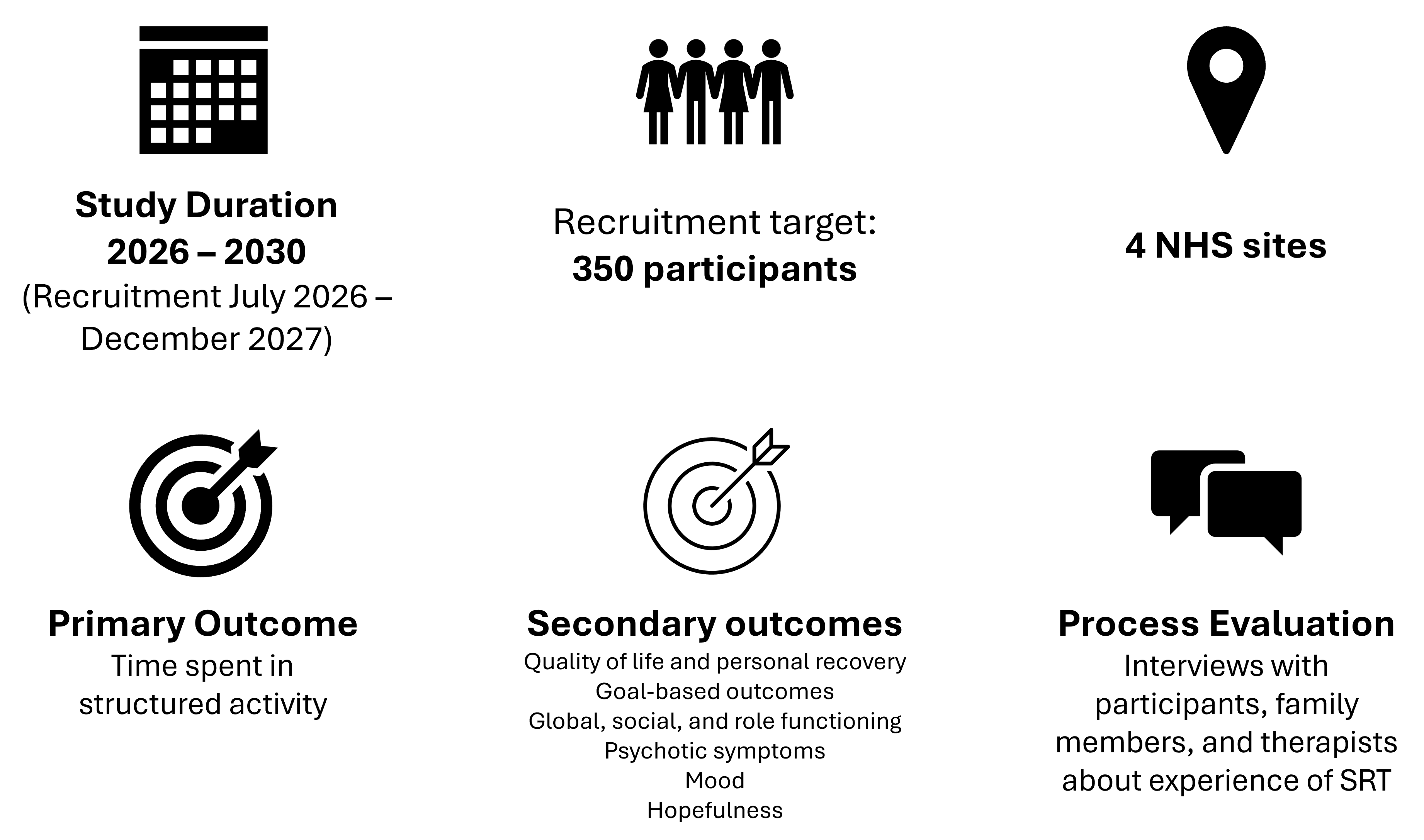
We are aiming to find out whether SRT improves social recovery for people with psychosis compared to their usual NHS treatment.

isrip summary

Taking Part

print-services-print-finishing-pen-lined-paper-notepad.jpg

What does taking part involve?

Each participant will be randomly assigned to one of two groups:

  • The intervention group, who will receive Social Recovery Therapy (SRT) plus their usual treatment. SRT will be delivered in 16 sessions over a period of 9 months.

  • The control group, who will receive their usual treatment only.

To help us understand if SRT has been effective, all participants will complete a range of assessments relating to social recovery and mental health at the start of the study, as well as 9 months and 15 months later.

clipboard and pen

Who can take part? (Inclusion criteria)

To participate in ISRIP, individuals must meet the following criteria:

✔ Have a diagnosis of non-affective psychosis

✔ Aged 18-65

✔ Spend less than 30 hours per week engaging in structured activity (e.g. work, leisure, housework), as determined by the Time Use Survey.

✔ Have a history of social impairment indicated by a score of <60 on teh Global Assessment of Functioning for more than 6 months.

✔ Have capacity and the ability to provide informed consent

NGEC enterprise, laptop and clipboard

Who cannot take part? (Exclusion criteria)

Individuals cannot participate in the trial if they meet any of the following criteria:

X The aetiology of their psychosis is organic (e.g. brain injury)

X They have severe learning disability which would prevent them from engaging with the SRT intervention or the assessments

X They are currently involved in any other interventional research study

X They pose an immediate serious risk to themselves or others

ISRIP logos banner 2

This study is funded by the NIHR Health Technology Assessment (NIHR169529). The views expressed are those of the author(s) and not necessarily those of the NIHR or the Department of Health and Social Care

Improving Social Recovery in Psychosis