Benefits of using CSNAT-I
Watch this video on the benefits of using CSNAT-I for carers and practitioners, explained by Kay Greene, formerly Director of Clinical Services, Mary Ann Evans Hospice.

These webpages are set up to provide access to a CSNAT Intervention Training Manual for those who want to use the CSNAT Intervention, but are unable to access the online CSNAT-I Training and Implementation Toolkit. For all other CSNAT Intervention resources and the online Toolkit, visit the CSNAT Intervention website.
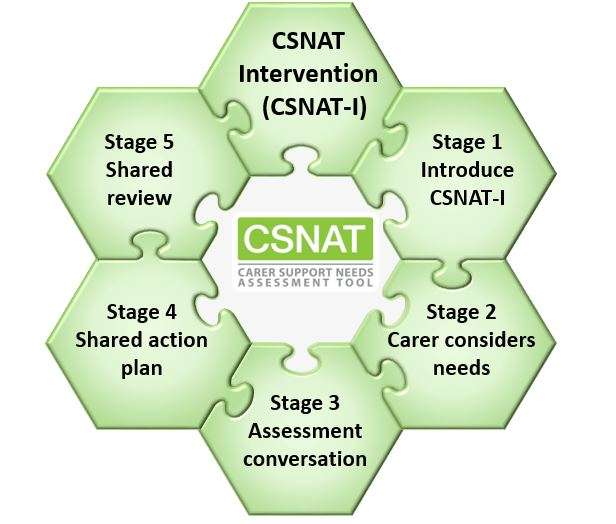
The CSNAT Intervention is for supporting carers (family members/friends in an unpaid supportive role), delivered using a five-stage person-centred process of assessment and support. The intervention uses an evidence-based, comprehensive tool comprising domains (broad areas of support need). The tool enables carers to identify, express and prioritise domains where they need more support. Then a needs-led conversation explores the carer’s individual needs and what they feel would be helpful, enabling the delivery of tailored support. Carers’ individual needs and shared actions identified to meet their needs are recorded on a Support Plan.
There are two types of intervention:
CSNAT-I for carers of adults with a chronic, progressive condition, including cancer
CSNAT-I Paediatric for parents/carers of children with a life limiting illness
All principles and procedures for CSNAT-I also apply to CSNAT-I Paediatric.
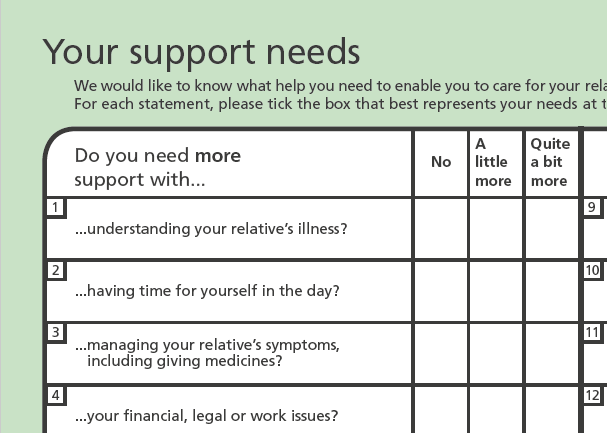
The CSNAT is an evidence based, comprehensive tool comprising a set of domains (broad areas of support need) in which carers commonly say they require more support. It acts as a prompt for carers to indicate where they need more support.
The tool was developed and validated in a series of research studies working with bereaved and current carers of patients with cancer and palliative conditions including COPD and MND/ALS.
The current version of CSNAT (V3) has 15 domains and includes an ‘anything else’ section where carers can write in any support need not covered by the other domains. It uses a simple question and answer format to ask which areas carers need more support with and what are their priorities for discussion.
CSNAT (V3) is intended for use with carers of people with chronic, progressive conditions, including cancer.
The CSNAT Paediatric (V2) uses a similar question and answer format, with 16 domains and an ‘anything else’ section. It is intended for use with parents/carers of children with a life limiting condition.
The tools are protected by copyright, which is why only an extract is shown here. Go to the Licensing section to download an inspection copy of each tool.
CSNAT-I is used mostly as an intervention for practice where the purpose of the tool (the CSNAT) is to help carers identify and express their support needs to a practitioner. It acts as a prompt to help start a needs-led conversation about carers’ unmet support needs which can then enable support to be tailored to meet their specific needs.
However, as the CSNAT is an evidence-based, comprehensive tool comprising domains (broad areas of support need), it can be used as a ‘standalone’ research tool. Its purpose as a research tool is to enable the identification of domains of unmet support needs within a research study.
The CSNAT Intervention Overview - Oct 2025Watch this video on the benefits of using CSNAT-I for carers and practitioners, explained by Kay Greene, formerly Director of Clinical Services, Mary Ann Evans Hospice.