New UEA spinout Nascent Therapeutics secures investment to advance revolutionary treatment for age-related conditions
By: RIN
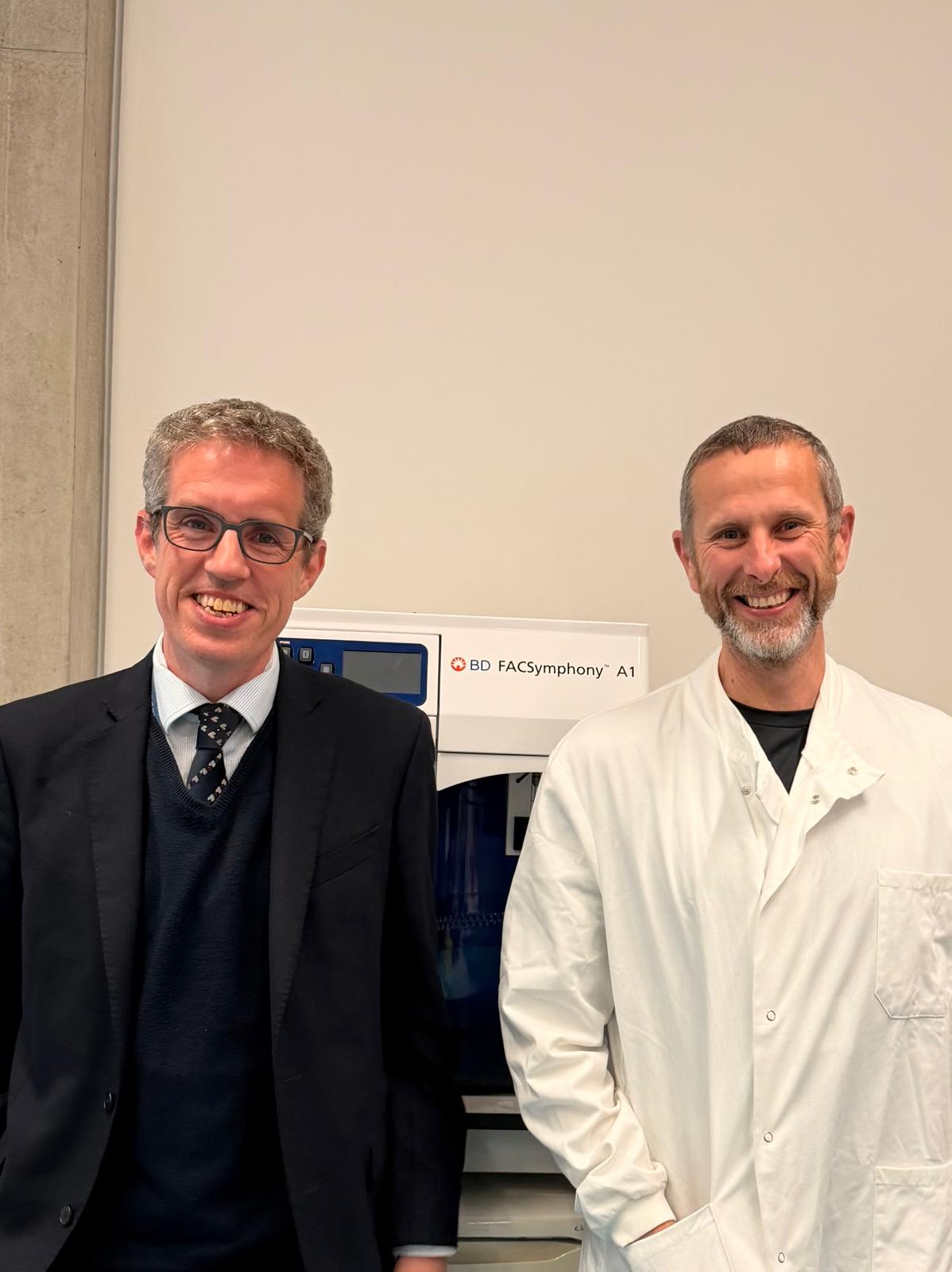
A spinout company from the University of East Anglia (UEA) is developing a revolutionary new approach to treating neurodegenerative diseases, cancer, and other age-related conditions.
Nascent Therapeutics was founded by Professor Stuart Rushworth, Director of Metabolic Health at Norwich Medical School, alongside the School’s Dean and Consultant Haematologist at the Norfolk and Norwich University Hospital, Professor Kristian Bowles.
The company is building a new class of disease-modifying therapies capable of tackling some of the world’s largest and most urgent unmet medical needs by targeting mitochondrial transfer.
Mitochondria are often described as the “powerhouses” of the cell, but their role extends far beyond energy production. They regulate metabolism, inflammation, oxidative stress, cell survival and are increasingly recognised as central to ageing and disease.
Mitochondrial transfer is the process through which cells transfer mitochondria between one another, through microscopic structures known as tunnelling nanotubes. This allows cells to share resources under stress and boost function. The process naturally rescues damaged cells, restores energy production, prevents cell breakdown and death, and is now believed to be able to be harnessed to treat a variety of conditions associated with age, like neurodegeneration, and cancer.
As we age, our mitochondrial function declines. Cells become less resilient, accumulate damage, and struggle to meet the demands placed upon them. Prof Rushworth’s lab developed a discovery platform that can detect mitochondrial transfer between cells, using patient‑derived samples, and Nascent Therapeutics is now applying this platform to develop first-in-class drugs to treat different diseases.
Professor Stuart Rushworth said: “This is an exciting development in the way we hope to be able to treat serious age-related disease in the future. We have identified the compounds that modulate mitochondrial transfer and are now taking forward the development of these compounds as novel drugs that could be used to treat patients with major unmet clinical needs in oncology and neurodegenerative disease.”
Prof Rushworth’s work was initially supported by a £75,000 grant from UEA’s Medical Research Council Impact Accelerator Account (MRC IAA) and an Innovation Development Award from UEA of £50,000 which enabled translational research and laid the foundations for the establishment of Nascent Therapeutics as a spinout company. The company has now been boosted by an investment of £750,000 from Zinc Venture Capital and Medicines Discovery Catapult (MDC). MDC's investment was funded by Innovate UK as part of a scheme that enabled Catapults to invest in high-potential companies.
Emilie Syed, Health & Life Sciences Principal at Zinc (who led the investment round) said:
“We’re proud to partner with Nascent as they work to translate their breakthrough science into a new generation of disease-modifying therapies. Nascent represents exactly the kind of ambitious Science-for-Impact venture Zinc exists to back: world-class science with the potential to transform how we tackle complex unmet health needs. The combination of pioneering mitochondrial biology, a proprietary drug discovery platform and a truly exceptional founding team makes this a particularly exciting opportunity."
Dr Mike Strange, Interim CEO of Medicines Discovery Catapult, added: “MDC works at the frontier of drug discovery, helping innovators turn bold scientific ideas into real-world impact. Nascent Therapeutics is a strong example of how innovative approaches originating from the UK’s research ecosystem can be translated to address unmet patient need. We are pleased to support the team, through Innovate UK-funded investment and MDC’s strategic expertise, as they advance potential new treatments for age-related disease."
Dr Nicola Hancock, Associate Pro-Vice Chancellor for Innovation (and Chair of UEA’s MRC IAA Board) said:
“It is tremendously exciting to see how successful the MRC Impact Accelerator Account has been in supporting the translation of UEA’s world-leading discovery science into life-changing medical treatments.
“The investments by Zinc and MDC into Nascent Therapeutics will ensure that Prof Rushworth’s important work can continue to develop, bringing much-needed therapies for many age-related illnesses closer to clinical impact.”
Nascent will initially focus on treatment for Parkinson’s disease, an area of enormous – and growing – unmet need. Current treatments for the disease primarily manage symptoms, but Nascent are seeking to preserve neuronal function for longer and deliver disease modifying therapies.
Co-founder and CEO Dr Stuart Wood commented: “We believe we can have disease-modifying effects. If we can preserve neurons we can slow the progression of diseases like Parkinson’s, ultimately, we can fundamentally change what ageing looks like.”
To find out more about other UEA spinout companies, visit: https://www.uea.ac.uk/business/partnering-for-innovation/spinouts
About Zinc
Zinc is a pre-seed venture capital firm backing ambitious founders building Science-for-Impact companies in health and the environment. Investing at the earliest stages, Zinc partners with exceptional teams right across the UK developing breakthrough science and deep technologies with the potential to create category-defining businesses. Through a combination of first-cheque investment and specialist venture-building support, Zinc helps founders de-risk scientific innovation, accelerate commercial progress and build companies capable of delivering both significant societal impact and long-term value creation.
Read more on the Medicines Discovery Catapult website.
Related Articles

UEA scientists develop ‘first of its kind’ home fertility test as global sperm counts plummet
University of East Anglia scientists have developed the first rapid at-home sperm test paired with a mobile app for personalised fertility advice.
Read more
Stark male-female differences revealed in autoimmune diseases misdiagnosed as mental health conditions
Females with autoimmune diseases are more likely than males to report mental health misdiagnoses and face longer diagnostic delays, University of East Anglia and Cambridge research has found.
Read more
UEA subjects among UK best in student-focused league tables
The University of East Anglia has climbed to the top of a new league table for a variety of subjects – with Norwich named the nation's leading university city.
Read more