UEA scientists develop ‘first of its kind’ home fertility test as global sperm counts plummet
By: Communications

University of East Anglia scientists have developed the first rapid at-home sperm test paired with a mobile app for personalised fertility advice.
With results in just 15 minutes, the new technology aims to give users a simple way to assess sperm health and fertility without the need for a visit to a specialist clinic.
The initiative comes amid growing concerns about male reproductive health, with global sperm counts having more than halved over the past 50 years.
The new test has been developed by UEA spin-out Virilitas Labs, based at Norwich Research Park and founded by scientists Prof Simone Immler and Dr Daniel Marcu.
The platform combines a rapid test with a companion mobile app that provides personalised health and lifestyle guidance, access to evidence-based information and support, and connections to fertility specialists where appropriate.
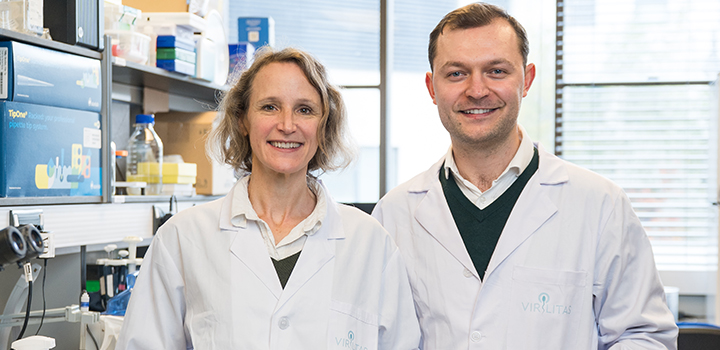
Image L-R: Prof Simone Immler and Dr Daniel Marcu. 2025 PHIL BARNES PHOTOGRAPHY
Prof Immler, professor of Genetics and Reproduction at UEA’s School of Biological Sciences, said: "Male fertility and reproductive health have been ill-served until now. One in six couples are affected by fertility issues of which approximately 50 per cent can be assigned to the male partner.
"In recent years, on average, sperm count has halved due to the impacts of climate change, increased stress, chemical additives in food, obesity and unhealthy diets."
The Virilitas test uses the same lateral flow technology found in Covid tests to analyse multiple biomarkers linked to fertility and reproductive health from a single semen sample.
Although other tests are currently available, these can have their limitations according to Prof Immler. She said: “Lateral flow devices currently on the market are inaccurate and cover only one factor, namely sperm number or motility, which is the ability of sperm to swim effectively towards an egg. This in itself is not a good measurement of overall male reproductive health or fertility.”
The test is being developed alongside a digital platform and app launched earlier this year to address what the company sees as a lack of accessible entry points into fertility care for men.
Dr Marcu, an expert in reproductive genetics at UEA, said: "Men don't engage with fertility care because there is no clear entry point designed for them. We're building Virilitas to solve that.
"The combination of our app, home testing kit and tech platform is designed to take users from confusion to action and ultimately into the right clinical support."
The app provides users with personalised guidance based on lifestyle and health behaviours, alongside support from a medically informed AI assistant trained on reproductive health guidelines.
Users can access educational resources, connect with others through a community hub, and arrange consultations with fertility specialists.
The founders say the goal is to encourage men to engage with reproductive health earlier and reduce the stigma that can prevent people from seeking support.
Prof Immler said: "Our proposition will hopefully start some serious dialogue on this issue and begin to provide people confronting infertility issues with clear guidance and measures of reproductive health that will help, support and signpost them towards resources that can make a difference.
"We are looking forward to finishing off the development work on our platform and testing kit and then scaling up with a manufacturer to make access to them as wide as possible.
“We are in active discussions with distributors in the UK and internationally to make our kit affordable and to enable customers to access a male fertility assessment without the need for a clinical referral."
The company has now received funding through Innovate UK's Biomedical Catalyst programme, which will support final development of the testing device, software validation, manufacturing preparation and regulatory approval processes.
Virilitas is working with Abingdon Health on manufacturing and is collaborating with Bourn Hall Fertility Clinic and the Norfolk and Norwich University Hospital on clinical validation.
The company was also a finalist in the Outstanding Commercialisation of Research category at the UEA Innovation & Impact Awards:
Considering your options for September? Clearing is your chance to find the course that fits you.
Be ready for results day with the latest updates. Register for Clearing updates.
Related Articles

Climate change damaging male fertility
Climate change could pose a threat to male fertility according to new research from the University of East Anglia.
Read more
Time restricted fasting could cause fertility problems
Time-restricted fasting diets could cause fertility problems according to new research from the University of East Anglia.
Read more‘Old’ sperm produces healthier offspring
Sperm that live for longer before fertilising an egg produce healthier offspring according to new research from the University of East Anglia and Uppsala University in Sweden.
Read more