Latest News

New Pro-Vice-Chancellor appointed for Medicine and Health Sciences
Prof Philip Baker will join UEA as Pro-Vice-Chancellor (PVC) for the Faculty of Medicine and Health Sciences from the University of Leicester, where he is currently PVC for Research and Enterprise, in February 2025.
Read more
Patients find it useful to receive quit smoking help while at hospital A&E
Giving out vapes at A&E boosted patients’ confidence to switch away from smoking, according to new research.
Read more
New analysis uncovers significant decrease in mental health staffing during austerity
The NHS mental health workforce decreased significantly during austerity, with notable disparity in staffing levels across the country, according to a new review.
Read more
UEA to host new unit for gastrointestinal study
Norwich will be the home of a new state-of-the-art health unit into the study of gastrointestinal infections, thanks to a £1.8m funding boost for the University of East Anglia (UEA) and a further £1m for the Quadram Institute Bioscience (QIB).
Read more
UEA to track a century of genetic change in Antarctic krill
UEA researchers are launching a project with the Natural History Museum to see how Antarctic krill are being impacted by climate change.
Read more
Swift intervention benefits elderly patients with heart condition
Early surgery for a common heart condition in the elderly can drastically improve their quality of life, a new study shows.
Read more
University of East Anglia to deliver a new Creative Writing MA course for the new creative economy
The University of East Anglia will deliver a New Creative Writing MA course focused on new forms, platforms and outlets for creative writing.
Read more
World's largest clinical trial to address disabling cognitive condition affecting one third of stroke survivors
A major new research trial, led by academics at the University of East Anglia (UEA) and taking place at eight major stroke centres across England, will explore a therapeutical solution to a disabling post-stroke condition.
Read more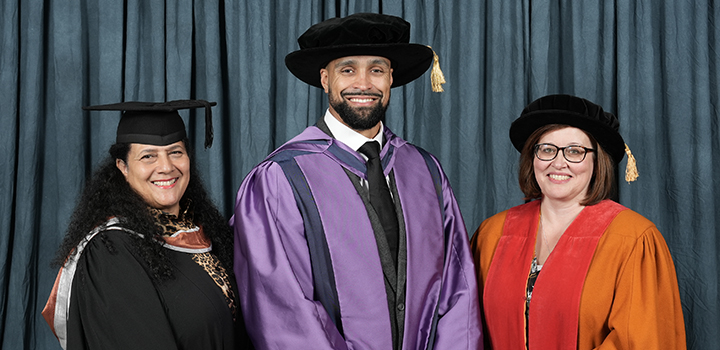
Honorary Doctorate for Diversity’s Ashley Banjo
Dancer, choreographer, and television personality Ashley Banjo MBE “humbled’ to receive an honorary degree from UEA through their partnership with South Essex Colleges’ University Centre.
Read more
New research identifies key mental health risk factors for children after trauma
A new study has shed light on why some children and adolescents develop mental health disorders like PTSD, anxiety, or depression after experiencing a traumatic event.
Read more
Wild birds’ health and likely survival is affected by the gut microbiome
Researchers have discovered that the gut microbiome affects the health of wild birds, which could impact their survival rates and ultimately population sizes.
Read more
Global CO2 emissions from forest fires increase by 60 per cent
A major new study reveals that carbon dioxide (CO2) emissions from forest fires have surged by 60% globally since 2001, and almost tripled in some of the most climate-sensitive northern boreal forests.
Read more