UEA expertise represented at key Westminster events
By: Communications
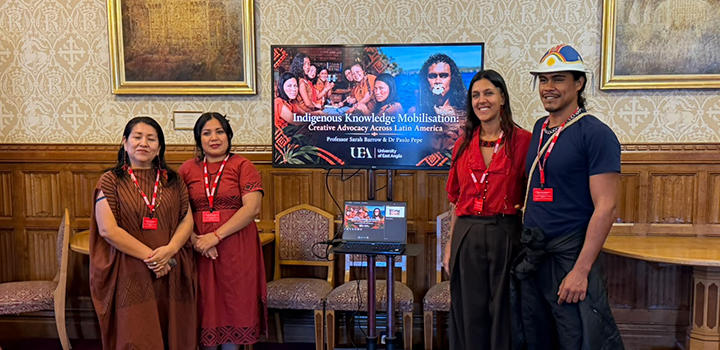
University of East Anglia researchers and partners helped bring global perspectives into national policy discussions this month, from conversations with Indigenous leaders to evidence given before MPs.
An Arts and Humanities Research Council-funded project brought Indigenous leaders, filmmakers and researchers from Peru and Brazil to London to share their experiences with politicians, officials and public audiences.
The visit formed part of Indigenous Knowledge Mobilisation: Creative Advocacy Across Latin America, which uses film and storytelling to help Indigenous communities raise awareness of issues affecting their lives.
During the week, Indigenous leaders, filmmakers and researchers participated in a policy briefing and campaign launch at the House of Lords, bringing Indigenous perspectives directly into discussions with policymakers and other stakeholders.
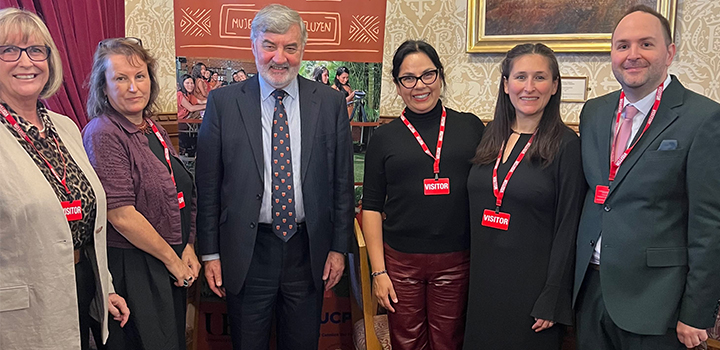
L-R: Prof Susan Hodgett, Prof Sarah Barrow, Lord John Alderdice (President of Peru Support Group), Prof Maria Eugenia Ulfe, Prof Eylem Atakav and Dr Paulo Pepe.
Documentary screenings at London's Garden Cinema also provided opportunities for public audiences to engage with Indigenous experiences, creative practices and contemporary struggles.
The project brings together two long-running UEA initiatives: Women of Influence in Peru and ORIGEM in Brazil.
Women of Influence works with young leaders from OMIAASEC, an organisation representing Indigenous Ashaninka women in the Peruvian Amazon. Together with partners, participants have created films, podcasts and educational resources exploring issues such as discrimination, deforestation, climate change, and food and water security.
ORIGEM is a collaborative project working with Indigenous LGBTQIA+ people in north-east Brazil, using filmmaking and creative practices to challenge dominant narratives, amplify Indigenous perspectives and explore questions of identity, belonging, representation and rights.
Prof Sarah Barrow, from UEA's School of Media, Language and Communication Studies, said: “It has been an incredibly rewarding and inspiring week, bringing together Indigenous leaders, filmmakers and academics from Brazil, Peru and the UK.
Ketty Marcelo Lopez, President of OMIAASEC, an organisation representing Ashaninka women in Peru, said: “This week has been an important opportunity to bring greater international attention to the realities facing Indigenous communities, while also highlighting the invaluable knowledge, experiences and perspectives we bring to addressing global challenges.
"It is essential that Indigenous peoples are recognised not only for the struggles we face, but also for the solutions we offer and our right to participate in decisions that shape our futures.”
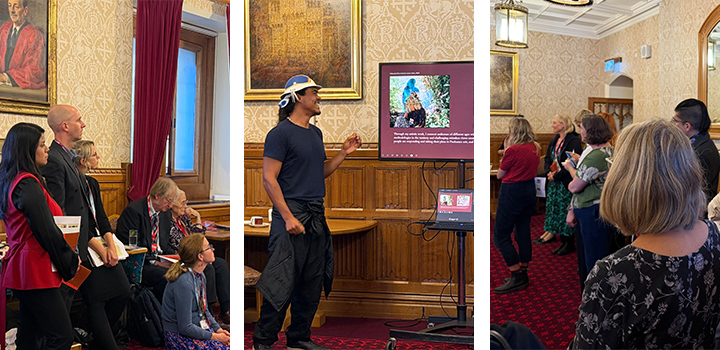
Image: Indigenous Knowledge Mobilisation: Creative Advocacy Across Latin America. Photographer: Taysir Correia.
Project co-lead Dr Paulo Pepe, from UEA’s Institute of Interdiscplinary Humanities, added: "What has made this week particularly significant is the opportunity for Indigenous leaders and filmmakers from Peru and Brazil to bring their knowledge, experiences and creative work into conversations that too often take place without their participation.
"Seeing these exchanges take place at UEA and the House of Lords demonstrates the importance of building collaborations that connect Indigenous knowledge, creative practice and political advocacy. We hope this marks the beginning of a much longer conversation."
The discussions formed part of wider conversations about the future of international development, the role of partnerships in tackling global challenges, and the contribution that creativity and culture can make to such work.
Fykya Pankararu, an Indigenous artist and participant in the ORIGEM project, said: “This was an important opportunity not only to showcase the richness of Pankararu culture, but also to bring our voices into political spaces where Indigenous peoples have historically been excluded.
“It allowed us to speak about the ongoing struggles our communities face, the protection of our territories, cultures and rights, and the importance of ensuring that Indigenous peoples are not only heard, but actively involved in decisions that affect our lives and futures.”
Informing parliamentary discussions
While Indigenous leaders and researchers were engaging policymakers at the House of Lords, UEA expertise was also being represented in Parliament.
Prof Adrian Martin, from UEA's School of Global Development, was invited to give evidence to the House of Commons International Development Committee as part of its inquiry into international partnerships and development.
Appearing alongside academics from The University of Edinburgh and London School of Economics, he discussed the value of international research partnerships, and the contribution universities make to tackling global challenges.
The session focused particularly on the role of higher education institutions in the UK's international development strategy and the implications of reduced Official Development Assistance (ODA) funding for research and collaboration.
Prof Martin said: “The Committee was keen to understand the role universities can play in the UK's international development strategy, particularly as ODA funding has declined.
"I highlighted the impact that development research can have and the important role ODA-funded programmes, such as the Global Challenges Research Fund, have played in bringing together researchers from different disciplines and strengthening partnerships between institutions in the UK and around the world.
“There was considerable interest in how these collaborations can be sustained in the future. While private investment has an important role to play, there was broad agreement that it cannot fully replace the unique contribution of public research funding in supporting long-term international partnerships.”
The session also highlighted the influence of UEA graduates working across the international development sector and in public life. Among those on the Committee were two UEA alumni, Labour MP Sam Rushworth and Liberal Democrat MP Brian Mathew, who now help scrutinise the UK's approach to international development and global partnerships.
Bringing different perspectives to the conversation
While the two engagements focused on different aspects of international development, both highlighted the importance of bringing a wide range of voices into the discussion.
From Indigenous leaders sharing experiences from communities in Peru and Brazil to UEA academics helping inform parliamentary scrutiny of UK development policy, the events showcased the different ways the University contributes to conversations on global challenges beyond campus.
Thinking about studying at UEA?
Discover our award-winning campus, meet current students and staff, and find out what life at UEA is really like at one of our upcoming Undergraduate Open Days:
Saturday 24 October 2026
Saturday 28 November 2026
Related Articles
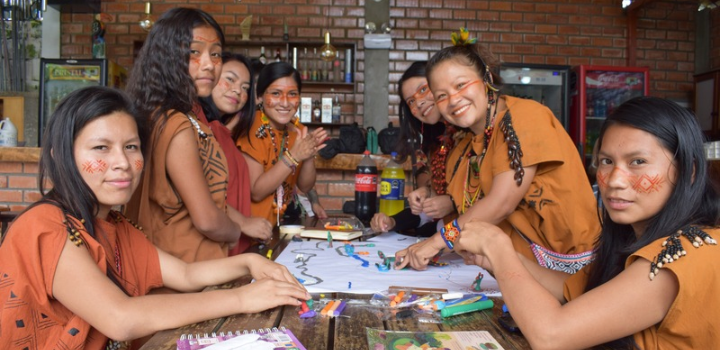
Cultural leaders from Peru and Brazil bring climate justice and Indigenous rights campaign to Westminster
Indigenous women leaders and LGBTQIA+ campaigners from Peru and Brazil are in London this week as part of a University of East Anglia project using creative storytelling to drive climate justice and Indigenous rights advocacy.
Read more
Han Kang, UEA-published author, wins 2024 Nobel Prize in Literature
The University of East Anglia (UEA) is once again celebrating the award of a Nobel Prize, after writer Han Kang, whose story, Europa, was published by UEA Publishing Project, won the 2024 Nobel Prize in Literature.
Read more
Innovation and Impact Awards now open for entries and nominations
The Innovation and Impact Awards are back for 2025 and looking to recognise and reward UEA’s most game changing staff, students, and graduates, and their collaborative work with partners outside the University.
Read more