Q&A with Dr Jessica Sharkey: The legend of Guy Fawkes and Bonfire Night
By: Communications
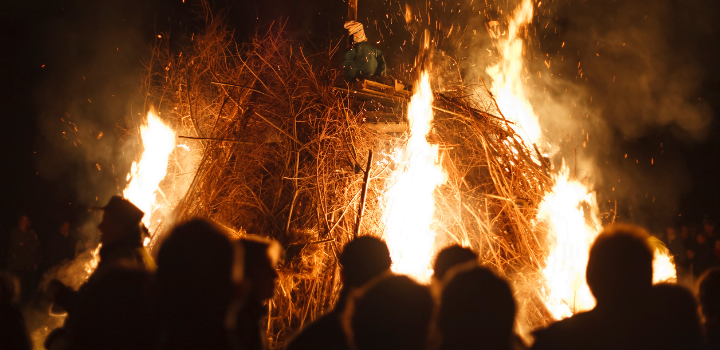
As the nation gears up for the dramatic finale of The Traitors UK tonight, Dr Jessica Sharkey from the School of History and Art History at the University of East Anglia, answers some questions on the history of Guy Fawkes - the man whose name has become synonymous with treason.
From the Gunpowder Plot of 1605 to the enduring legacy of Bonfire Night, Dr Sharkey sheds light on the motivations, myths, and political tensions that surrounded one of the most well-known traitors in British history.
Q: Who was Guy Fawkes, and why is he such a significant figure in British history?
Guy Fawkes was a member of the minor gentry, which today would be considered upper middle class, and most importantly, he was a Roman Catholic. That matters because at the time he lived, Roman Catholics were excluded from holding public office. They couldn’t be MPs, lawyers, or participate in public life, and their religion was essentially illegal.
Q: What was the Gunpowder Plot, and what role did Fawkes play in it?
Fawkes became involved in a conspiracy to destroy the English establishment by blowing up the Houses of Parliament. He and his fellow plotters chose the state opening of Parliament in 1605 for their attack. That day would see King James I, a Protestant, in attendance, along with his eldest son and heir, his closest advisers, bishops of the Church of England, members of the House of Lords, and all MPs.
They rented a storage room beneath the House of Lords and stored 36 barrels of gunpowder there. Guy Fawkes was the man chosen to light the fuse.
Q: How was the plot discovered?
The traitors were betrayed. A letter was sent to a Catholic-leaning member of the House of Lords warning him that Parliament was going to suffer a great blow. This led to a search of the cellars, where they found a shadowy figure loitering near the barrels of gunpowder - Guy Fawkes himself. He was arrested, tortured, tried, and sentenced to a gruesome death.
Q: What happened after the plot failed?
Immediately after 1605, laws were passed to ensure annual celebrations in remembrance of the failed plot. Bonfires were lit, and prayers were offered for the safety of the English establishment and the king. But over time, Guy Fawkes’ legacy has become more complicated.
Q: How has Guy Fawkes’ image evolved in modern culture?
Perhaps most famously, in the 1980s, Alan Moore wrote V for Vendetta, a graphic novel where the central character wears a Guy Fawkes mask to overthrow an authoritarian regime. That mask has become iconic in popular culture and is now a symbol of protest across the political spectrum and around the world.
Q: What does the Guy Fawkes mask represent today?
It’s a symbol of concealed identity. When people wear it, are they hiding a nefarious plot, or are they masking something else? It also brings up moral ambiguity - are we right to root for a traitor’s victory, or should we stay loyal to the establishment? That’s for you to decide. But as for me - I’m totally Team Alan.
Dr Sharkey’s traitorous look is lighting up UEA social channels with The Traitors UK final tonight- the castle may be far away, but the history of betrayal is right here at UEA. Watch now:
Related Articles
UEA academic serves as historical consultant for new BBC Radio 4 series
A leading University of East Anglia (UEA) historian has contributed expert analysis to a major new BBC Radio 4 series presented by broadcaster David Dimbleby.
Read more
Lost letter from the Pope casts 1066 as a holy war against ‘followers of Satan’
A lost letter from the Pope could rewrite the story of 1066 – according to research from the University of East Anglia.
Read more
Graduation 2026: The mature students proving it’s never too late to learn
Mike Marshall and Tony Pearse have proved that determination and perseverance can turn even the longest-held dreams of higher education into reality.
Read more