Norwich Medical School graduate ready to whisk up success on Bake Off
By: Communications
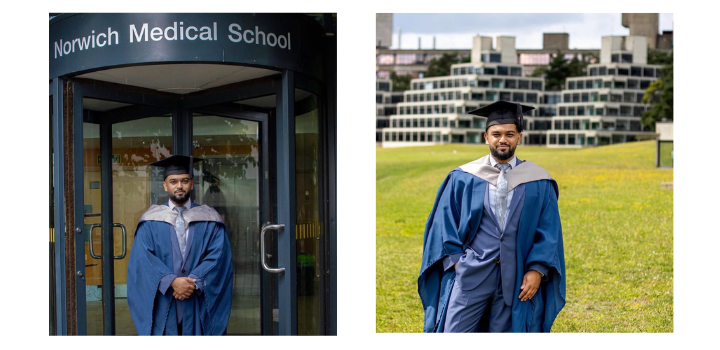
The UEA community is hoping Norwich Medical School graduate Dr Yannis has the perfect recipe for Great British Bake Off glory.
Yannis will be stepping into the famous tent as a contestant in the new series of the hit Channel 4 show, which starts tonight (Tuesday, September 22).
Yannis graduated from Norwich Medical School in 2023 and now works as a paediatrician at a hospital in London, where he lives.
His love of baking developed during the Covid-19 lockdowns. With he and his flatmates spending long periods confined to their rooms and studying online, baking became a creative outlet and a way to connect with others during a challenging time.
What started as a lockdown hobby has since grown into a serious interest, earning him a place among this year's Bake Off contestants.
During his time at UEA, Yannis made a significant contribution to student life. He was a member of the Bengali Society and founded the UEA Emergency Medicine Society, bringing together students with an interest in emergency medicine.
Now, he will swap the hospital ward for the Bake Off tent as he takes on the programme's signature, technical and showstopper challenges in front of a national audience.
Good luck, Yannis. The UEA community will be watching with interest to see if your baking skills can rise to the occasion.
Thinking about studying at UEA?
Discover our award-winning campus, meet current students and staff, and find out what life at UEA is really like at one of our upcoming Undergraduate Open Days:
Saturday 26 September 2026
Saturday 24 October 2026
Saturday 28 November 2026
Related Articles

How dismissed symptoms can push patients to breaking point
Patients have been left feeling suicidal after feeling like their doctor was saying their symptoms were ‘all in their head’ – according to research from the University of East Anglia and the University of Cambridge.
Read more
‘Hiding in plain sight’ – new bacteria discovered in DNA samples from prostate cancer patients
University of East Anglia researchers have discovered the genetic blueprints of 18 new bacterial species collected from prostate cancer patients.
Read more
Thousands of heart patients could avoid permanent stents
Thousands of heart patients could be treated without having a metal stent permanently implanted in their arteries – according to research from the University of East Anglia.
Read more