New book reveals evolution of Santa Claus legend
By: Communications
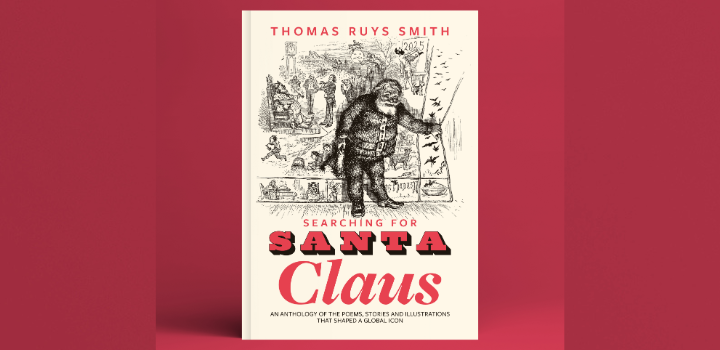
A new book by an academic at the University of East Anglia (UEA) offers readers a rare glimpse into the literary and artistic origins of one of the most beloved figures in popular culture.
Through a collection of poems, stories and illustrations, the landmark anthology Searching for Santa Claus traces the evolution of Santa Claus from his earliest appearances in print to the universally recognized character who now dominates the festive season.
Fresh perspective
Santa Claus appears throughout popular culture, captivating the imaginations and shaping the wishes of millions of children across the world - but he only came into focus as a social and cultural icon relatively recently, in the 19th century.
By bringing these portrayals together for the first time, the book offers a fresh perspective on how Santa’s character was shaped - his sleigh, reindeer, workshop, helpers, and even Mrs Claus, all crafted by American writers and artists during the 19th century.
Prof Thomas Ruys Smith from UEA’s School of Philosophy, Politics and Area Studies, explains that Santa Claus is not just a seasonal figure, he’s a cornerstone of childhood memory.
“He’s everywhere in the winter months, yet surprisingly little is known about how he came to be,” said Prof Smith. "This is the first time that these important stories, poems and illustrations have been brought together in one place.
“All of these essential portraits of Santa Claus were hidden away in 19th century newspapers, magazines and books on both sides of the Atlantic, and it's only when they're brought together that it's possible to really understand how Santa Claus grew and developed as a character.
“It gives us a whole new perspective on the history of our Christmas celebrations and Santa's role in them. Readers will meet Santas who look very familiar, and some who seem very strange! But they were all pivotal for shaping the character who visits our homes every Christmas today.”
Shaping the legend
When he started looking into the history of Santa Claus, Prof Smith was amazed at how difficult it was to track down the most important stories that shaped and spread the legend around the world.
“Throughout the 19th century, American writers and artists built Santa Claus a life and a world that we know so well today - his reindeer, his workshop, his helpers, his wife, and everything else we associate with him as a character.
“That's an amazing literary accomplishment that shouldn't be hidden away in archives. Taken together, in terms of how it shaped our seasonal behaviour now and then, this should be considered one of the most influential collections of poems, stories and illustrations of all time.
“It's because of these stories that millions and millions of children across the globe will hang up their stockings this Christmas Eve.”
Prof Smith added: “I hope this book will give readers a better understanding of the traditions and the characters that make their Christmas magical. I hope it gives readers a new respect for Santa Claus, too, as one of the richest figures in popular culture.
“Mainly, though, I hope that it gives readers, young and old, some seasonal literary cheer, because it's filled with delightful stories and poems that should be much better known.”
Prof Smith specialises in the study of 19th century literature and culture. He is the author and editor of a wide range of books including The Last Gift: The Christmas Stories of Mary E Wilkins Freeman (Louisiana State University Press, 2023).
Searching for Santa Claus: An Anthology of the Poems, Stories and Illustrations That Shaped a Global Icon is published by Boiler House Press in the UK on November 11 and in the US on November 28.
Related Articles

Electoral integrity under pressure as elections faced persistent threats in 2025
Elections across the world faced a wide range of pressures on electoral integrity in 2025, from violence and mis- and disinformation to electoral management malfunctions, cyber attacks and natural hazards, according to a new report.
Read more
UEA subjects among UK best in student-focused league tables
The University of East Anglia has climbed to the top of a new league table for a variety of subjects – with Norwich named the nation's leading university city.
Read more
Dame Jacqueline Wilson to judge creative writing competition about inspirational animals
Aspiring writers of all ages have the chance to impress novelist Dame Jacqueline Wilson in a unique competition hosted by UEA, Redwings Horse Sanctuary and The Pony Club.
Read more