How sex can help save species from extinction
By: Communications
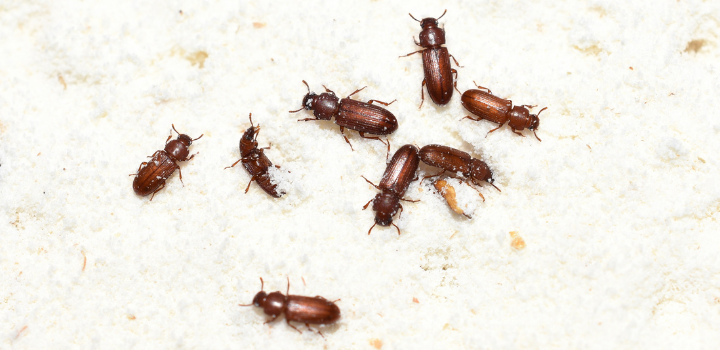
Giving females multiple males to mate with, rather than just one, could help make species more resistant to extinction – University of East Anglia research shows.
A new study reveals that when females have multiple males to mate with, their offspring inherit significantly fewer harmful genetic mutations. This, in turn, makes the entire population healthier and less likely to die out.
The findings, published today in the journal PNAS, emerged from a 15-year experiment involving thousands of red flour beetles.
But the team say it supports a long-standing evolutionary theory that could apply across much of the animal kingdom.
How the research happened
Researchers compared beetle populations in which females had just one male to mate with, with populations where females could mate in a competitive environment involving multiple males. After 156 generations, populations exposed to stronger sexual selection carried substantially fewer harmful genetic mutations. This was because females had greater choice of mates and males faced more competition to reproduce, compared with populations where mating opportunities were restricted.
Lead researcher Dr Michael Pointer, from UEA’s School of Biological Sciences, said: “In one type of population, females could mate with up to five males in each generation.
“In the other type, the opportunity for sexual selection was removed by pairing each female with just one male each generation.
“We then sequenced the genomes of multiple beetles from each population and identified the different mutations within those genomes, including those predicted to be harmful.
“We found that when the females had more males to potentially mate with, those populations had fewer harmful mutations, but similar overall genetic diversity.
Healthier genomes
“In simple terms, we found that populations of beetles where there were multiple males that the female could potentially mate with ended up with healthier genomes.
“This genetic advantage appeared to have real-world consequences because populations carrying higher levels of harmful mutations were far more likely to become extinct when subjected to inbreeding.
“Indeed, this mutation load proved a better predictor of extinction risk than the mating system itself,” he added.
Evidence for the ‘good genes’ hypothesis
The study offers evidence for a long debated evolutionary idea known as the ‘good genes’ hypothesis
The theory suggests that successful males tend to be those with the best genes - in this case those with the fewest harmful mutations.
When females can choose between competing males, or when males compete intensely for matings, those with poorer genetic health are less likely to pass on their genes.
“Over many generations, this process acts like a biological quality-control system, helping purge damaging mutations from the population,” said Dr Pointer.
“Our work provides direct genomic evidence for this hypothesis.”
The researchers found that this genetic filtering occurred without reducing overall genetic diversity. Previous concerns had suggested that strong sexual selection could reduce the breeding population and lead to a loss of genetic variation
But the beetles exposed to stronger sexual selection retained similar levels of genome-wide diversity to those in the low-selection population.
“This means that populations may be able to rid themselves of harmful mutations while still preserving the genetic variation needed to adapt to future challenges,” said Dr Pointer.
Important implications for conservation
Senior author Prof David Richardson, also from UEA’s School of Biological Sciences, said: “Many endangered species suffer from small population sizes and inbreeding, which allows harmful mutations to be expressed and lead to increased extinction risk.
“Conservation programmes, whether in the wild or captivity, should think carefully about restoring natural levels of sexual selection.
“Allowing females multiple males to mate with could help populations to naturally weed out damaging genetic variants and improve their long-term chances of survival.
“Experimental beetle populations allow us to test fundamental evolutionary principles over hundreds of generations, something that would be impossible in larger animals.
“The aim was not to understand the beetles themselves, but to investigate a broader question that has puzzled evolutionary biologists for decades – why sexual reproduction remains so widespread despite its enormous costs.
“One reason may be that sexual selection helps populations get rid of harmful mutations.
“The battle for mates may help nature battle against extinction.”
This research was led by UEA in collaboration with the Earlham Institute. It was funded by the Natural Environment Research Council (NERC) and the Biotechnology and Biological Sciences Research Council (BBSRC).
‘Sexual selection purges mutation load, but not overall genetic diversity, decreasing vulnerability to extinction’ is published in the journal PNAS.
Related Articles

Annual Bishop of Norwich Prize for Ecology awarded to UEA graduate
University of East Anglia (UEA) master’s graduate, Adam Bourton, has won the 2026 prize for his conservation work with beach-nesting birds in North Norfolk.
Read more
UEA among global elite for research collaboration
The University of East Anglia has been recognised as one of the best in the world for research collaboration in a major new ranking.
Read more
UEA scientists develop ‘first of its kind’ home fertility test as global sperm counts plummet
University of East Anglia scientists have developed the first rapid at-home sperm test paired with a mobile app for personalised fertility advice.
Read more