Ancient DNA reveals identity of Europe’s earliest dogs
By: Communications
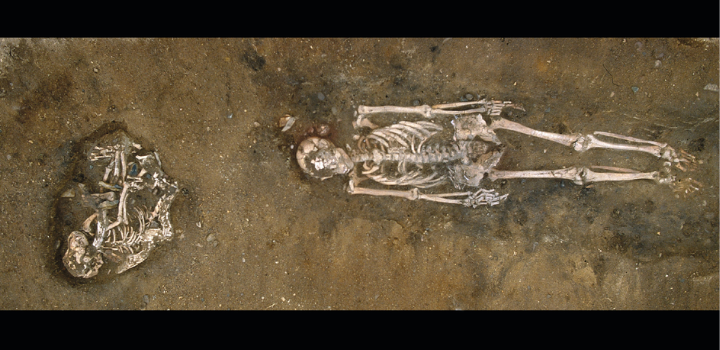
A researcher at the University of East Anglia has helped uncover the identity of one of Europe’s earliest known dogs.
Found in Switzerland, the dog’s remains have been dated to 14,200 years ago.
The breakthrough comes from the largest study of ancient dog DNA ever conducted and pushes the genetic evidence for dogs back by several thousand years.
Published in Nature, the research sheds light on the complex history of dogs - the first animal to form a domestic relationship with humans - and resolves the identity of the earliest known dog remains in Europe.
It reveals that dogs were domesticated towards the end of the last Ice Age - even before the advent of farming.
Lead researcher Dr Anders Bergström, from UEA’s School of Biological Sciences, said: “The UK is home to nearly 13 million pet dogs – about one-in-three households. Dogs have been ‘man’s best friend’ throughout living history, but when did we first adopt these furry companions, and how have they evolved since then?
“We wanted to find out.”
How the research happened
Led by scientists at the Francis Crick Institute, UEA and the Max Planck Institute for Evolutionary Anthropology, scientists analysed the genomes of 216 ancient dog and wolf remains found in Europe and surrounding regions.
The skeletal remains included 181 samples that predated the Neolithic period some 10,000 years ago - before the invention of farming.
These samples came from sites across Europe and its vicinity, including Switzerland, Germany, France, Belgium, the Netherlands, Türkiye (Turkey), Sweden, Denmark and Scotland.
The researchers used a method called ‘hybridisation capture’ to increase the amount of usable DNA. They designed probes that could ‘fish out’ dog and wolf DNA from the large amounts of bacterial DNA that usually contaminate very old remains.
Distinguishing dogs from wolves
These new genomic techniques allowed the team to distinguish early dogs from wolves in around two thirds of the remains - a major leap forward in a field where skeletal features alone often prove misleading.
The oldest specimen was an early dog from the Kesslerloch site in Switzerland, which was radiocarbon dated to 14,200 years ago.
It joins a 15,800-year-old dog from Türkiye (Turkey), analysed as part of a related study also published in Nature today, led by the Natural History Museum, the University of Oxford and LMU Munich.
Dr Bergström said: “Without using these advanced genetic tools, we wouldn’t be able to confidently distinguish dogs from wolves based on skeletal evidence alone.
“As the Kesslerloch dog was already more similar to later European dogs than those in Asia, dogs must have been domesticated well before this point.
“Yet, many questions remain. We’re still researching where and how dogs spread across Europe after likely domestication somewhere in Asia. Each piece of evidence is a step forward in this journey.”
How the first farmers adopted hunter-gatherer dogs
The study offers fresh insight into what happened when farming spread into Europe around 10,000 years ago.
As agriculture moved westward from Southwest Asia - bringing people, plants and animals - Europe’s hunter gatherer populations were gradually displaced or absorbed. Dogs, however, appear to have followed a somewhat different trajectory.
Dr Bergström said: “Genetic modelling suggests that the dogs belonging to these early farming groups interbred extensively with the resident hunter gatherer dogs already present in Europe.
“Those prehistoric European dogs contributed substantially to the genetic makeup of later Neolithic dogs - and, ultimately, to many modern European breeds.”
Dr Pontus Skoglund, Senior Group Leader of the Ancient Genomics Laboratory at the Crick and senior author, said: “Dogs were the only domesticated animal to predate farming, so their evolution can help us understand how a big shift in lifestyle shaped our own history.”
The legacy of these European hunter-gatherer dogs is still around today, with most popular European dog breeds tracing about half of their ancestry to the dogs that lived in Europe before farming.
“Most of the dogs running about in a local park today trace some of their ancestry to dogs living in Europe over 14,000 years ago,” said Dr Skoglund.
“It’s fascinating that we’ve walked alongside each other for so many thousands of years, despite considerable changes in human lifestyles.”
Though the study answers some long standing questions, others remain. The precise origins of domestication - geographically and culturally - are still uncertain. But with each newly sequenced bone fragment, the picture becomes clearer.
Related Articles

Ancient wolves on remote Baltic Sea island reveal link to prehistoric humans
Scientists have found wolf remains, thousands of years old, on a small, isolated island in the Baltic Sea – a place where the animals could only have been brought by humans.
Read more
Annual Bishop of Norwich Prize for Ecology awarded to UEA graduate
University of East Anglia (UEA) master’s graduate, Adam Bourton, has won the 2026 prize for his conservation work with beach-nesting birds in North Norfolk.
Read more
UEA among global elite for research collaboration
The University of East Anglia has been recognised as one of the best in the world for research collaboration in a major new ranking.
Read more