Walking without being wired: Academics help hotel guests go digital-free with hand drawn maps
By: Communications
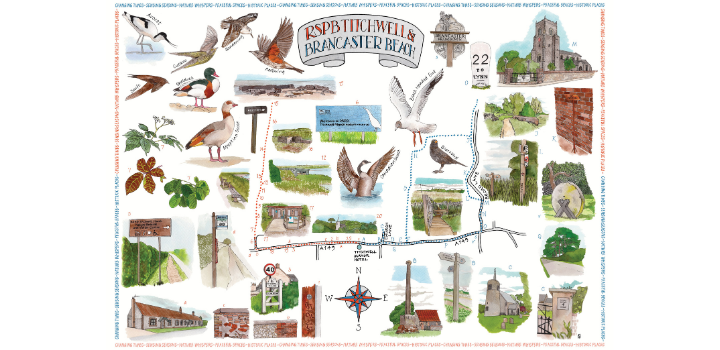
Digital detox researchers have teamed up with a Norfolk hotel to help guests slow down, switch off and reconnect with their surroundings – using specially created hand-drawn walking maps to guide them along the county’s coastline and countryside.
Situated on the North Norfolk coast, staff at Titchwell Manor Hotel were inspired by the work of Prof Brad McKenna from the University of East Anglia (UEA) and Dr Wenjie Cai of the University of Greenwich.
The academics have previously investigated the benefits of disconnecting from technology and social media while travelling, and how it impacts holiday experiences.
After hearing about their work, the hotel decided to support guests and visitors to go digital-free with the creation of bespoke artisan paper maps of the surrounding area, officially launching them this month – National Walking Month.
“In our research we found that having a disconnected experience while travelling can enable people to be more attentive and focused on their surroundings and allow for more engagement with local people and the physical environment,” said Prof McKenna, whose work at UEA’s Norwich Business School includes researching the social implications of technology use.
“When going digital-free participants also talked about how to navigate when you can no longer follow the blue dot on a mobile map. With this project, we wanted to find out if using a more creative kind of map could be more helpful to guests in enabling digital-free navigation as opposed to using an Ordinance Survey one, for example, which can be quite intense for a first-time user.”
Prof McKenna added: “These beautifully drawn maps will hopefully encourage visitors to leave their tech at the door, in the car, or even at home, to rest and observe and take in their environment. With the information on the back of them you also learn a little bit about each point of interest that you come to, which I really like.”
Caroline Southard, one of the managers at Titchwell Manor, recruited volunteer walkers from the local Kings Lynn Town Guides group to explore specific routes around the property, highlighting points of interest such as historical landmarks and natural features.
With this information artist and map-maker Chrissie Nicholls, known as Inkpot & Pen and specialising in hand-drawings that focus on the interesting details on a route, then walked them herself before creating the illustrations for the printed maps.
Ms Southard said: “We are situated in a unique position, a stone’s throw from the sea and surrounded by marsh, meadow and with views to the beach. This means many of our guests enjoy Norfolk’s natural elements from the doorstep of the hotel, whether that be on foot discovering local landmarks or looking up at the wide expansive skies, beautiful sunsets and occasional northern lights.
“By creating these bespoke maps, we hope our guests will be able to fully switch-off, immerse themselves in their surroundings and slow down. It’s about reigniting the appreciation for what’s around you and the illustrations on the map are showing you so many different elements and cues to help that happen.”
The hotel is opposite the RSPB bird sanctuary Titchwell Marsh Nature Reserve, which features on one of the four illustrated routes. They range from three to five miles and also cover Brancaster Beach, Barrow Common and the Norfolk Coastal Path, and Branodunum Fort.
Dr Cai, Associate Professor in Tourism at the University of Greenwich, said: “People have gone to extremes to go digital-free, such as taking themselves off to remote cabins, but not everyone is going to be able to do that.
“With these maps we’re hoping to show that you can still get away and slow down, let go and take in the atmosphere around you without going that far, but from the door of the hotel instead.”
The maps will be available in common areas of Titchwell Manor to prompt interaction and inspire guests to enquire about routes and seek guidance from hotel staff.
Ms Southard added: “This organic, artisan approach is designed to foster deeper engagement with both the local environment and the hotel team, encouraging a meaningful, digitally-free exploration experience that also enhances our commitment to immersive, sustainable tourism.”
As well as the maps, the hotel is looking at offering to lock guests’ phones away and switch off TVs in bedrooms during their stay, to help them make the most of going digital-free.
Prof McKenna received funding for the project from the Arts and Humanities Research Council Impact Acceleration Account (IAA), awarded to UEA’s Faculty of Arts and Humanities. The aim of IAA funding is to create impact from existing research through projects aimed at non-academic audiences that enhance society and the economy in creative ways.
Related Articles
New guide puts Indigenous Peoples, local communities and rights at the heart of ecosystem restoration
A major new report outlines how experts can better place Indigenous Peoples and local communities at the heart of decision-making in ecosystem restoration efforts.
Read more
New study reveals phone-free holiday can provide wellbeing reset
Research from the University of East Anglia has revealed that digital-detox trips can help people slow down, reconnect with their surroundings and reassess their relationship with technology.
Read more
UEA students experience real-world business challenges in Australia
Students at the University of East Anglia have been given the chance to gain valuable international experience in real-world business challenges through a skills boosting programme in Australia.
Read more