UEA scientist leads Westminster call for sustained investment in astrophysics
By: Communications
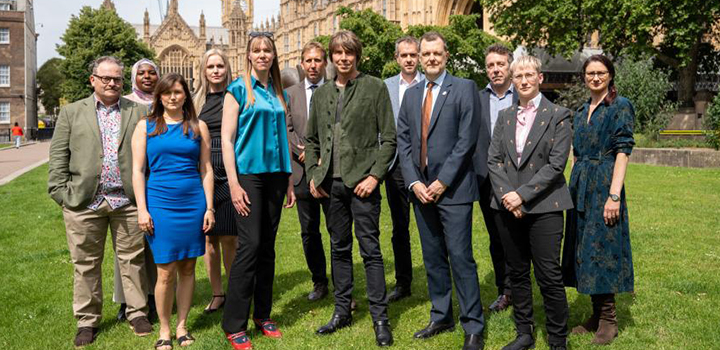
A space scientist from the University of East Anglia (UEA) joined forces with TV’s Brian Cox and MP Clive Lewis to campaign for continued investment in astrophysics at Westminster yesterday.
The event brought together leading physicists, astronomers and policymakers to call for continued UK investment in astrophysics and particle physics.
Dr Robert Ferdman, from UEA's School of Engineering, Maths and Physics, was part of a high-profile delegation that included Prof Brian Cox, Prof Catherine Heymans, Astronomer Royal for Scotland, and Norwich South MP Clive Lewis.
The event brought MPs face-to-face with leading scientists to demonstrate the impact of astrophysics research - from advancing our understanding of the universe to driving economic growth, innovation and skills across the UK.
Organised in partnership with the Royal Astronomical Society (RAS), the event was driven by Dr Ferdman following discussions with Clive Lewis MP on the need to strengthen funding via the Science and Technology Facilities Council (STFC), part of UK Research and Innovation (UKRI).
Dr Ferdman said: “While UKRI is seeing record investment, curiosity-driven research in astronomy, particle and nuclear physics is expected to suffer a real-terms decrease of up to 30 per cent over the next few years.
“This is catastrophic for researchers who rely on grant funding from the STFC to carry out the cutting-edge work that has long been associated with UK scientific leadership.
“These cuts would very likely lead to a large exodus of early-career researchers. In a recent survey, nearly 80 per cent said they are considering leaving the UK.
“Not only would UK space and fundamental physics output decline, but our international reputation as both a leader and collaborator would take a significant hit. This includes our role in major global projects such as the Vera Rubin Observatory and the Large Hadron Collider.”
Prof Brian Cox said: “We live in a time of rapid scientific and technological change and opportunity, largely driven by advances in AI, quantum technologies and the expansion of the global economy into space.
“The UK has the expertise, heritage and potential to play a leading role in these transformative technologies, but our ability to do so is threatened by these ill-considered cuts, which appear to have been cooked up in haste in response to vague political messages about focusing on government priorities.
“Damaging two of the most vibrant, challenging and productive areas of physics at a time of increased global competition and unprecedented intellectual challenge is inexplicable to me.”
Clive Lewis, Labour MP for Norwich South, said: “MPs and peers need to understand what these cuts really mean.
They’re not just numbers on a spreadsheet. They mean fewer opportunities for early career researchers, weaker research teams and more pressure on universities already struggling to hold the line.
“The economic implications of these cuts will be damaging. But so too will the impact on our ability to understand the universe around us. It really is a case of burning the furniture to keep warm.
“The proposed cuts matter here in Norwich too. UEA and universities like it need stable funding, skilled researchers and the ability to attract and keep talent.
“I will keep fighting for proper science funding, for universities, and for the people who make British science world-class.”
The initiative formed part of a growing national effort to protect funding for fundamental physics, underlining UEA’s leadership in shaping science policy and advocating for the future of UK research.
Related Articles
UEA subjects among UK best in student-focused league tables
The University of East Anglia has climbed to the top of a new league table for a variety of subjects – with Norwich named the nation's leading university city.
Read more
UEA’s grant and funding success – January 2026
Discover the latest research and funding grant successes happening within the University of East Anglia.
Read more
UEA and Hethel Innovation building on solid foundations with new Memorandum of Understanding
UEA and Hethel Innovation have strengthened their longstanding collaborative partnership with the formal signing of a strategic Memorandum of Understanding, recognising a shared commitment to innovation and sustainable economic growth.
Read more