Tony realises his degree dreams forty years on
By: Communications
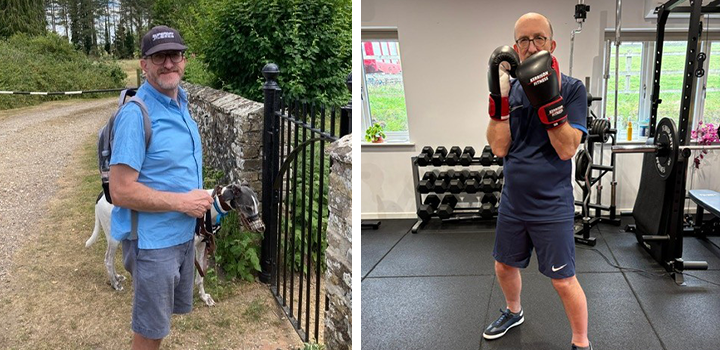
UEA Modern History student, Tony Pearse, will graduate this summer after finally pursuing the degree he first dreamed of more than 45 years ago.
Returning to full-time study at the age of 60, Tony, who lives in Harleston, Norfolk, with his wife and greyhound, began his degree following a period of profound illness and recovery. Diagnosed with Parkinson’s disease in 2020 and later with dementia, Tony has defied significant health challenges in pursuit of his lifelong passion for history.
A lifelong love of history rediscovered
“History has fascinated me all my life,” Tony said. “My parents lived through some of the most turbulent events of the 20th century, and those stories stayed with me. That’s where my interest in history started.”
Originally from Suffolk, Tony’s early education was cut short due to financial pressures at home despite receiving an offer to study Medieval History at university. Instead, he entered the workforce, spending decades in public service, healthcare training, logistics, transport and retail.
Returning to education after ill health
Following forced retirement due to ill health in 2022 and a period of acute mental illness, Tony, who is now 63, applied to UEA after encouragement from a mental health professional who had herself returned to study as a mature student. After completing a preparatory short course, he joined UEA in September 2023.
“When I applied, I didn’t think I was qualified or that I was capable. But I was encouraged to try – and that changed my life.”
Returning to education later in life brought challenges alongside rewards. “On my first day, I honestly didn’t think I belonged,” Tony recalls. “Waiting to collect my campus card from the Student Information Zone, I began to turn and look for the exit. Someone must have noticed my panic and pulled me out of the queue. They calmed me down and reassured me I belonged and had earned my place. That moment changed everything.”
The power of support at UEA
Managing Parkinson’s and dementia alongside a demanding academic programme has required significant adjustments. Loss of mobility, severe anxiety, tremors, memory loss, and the inability to write legibly meant Tony has relied heavily on reasonable adjustments and specialist support, including a dedicated scribe and online teaching access.
“The support at UEA has been extraordinary,” he said. “No one ever told me I couldn’t. Every issue has been met with solution‑finding, not barriers.”
Tony is keen to acknowledge the role of UEA’s Learning Enhancement Tutor, Zoe Jones, alongside his scribe and academic advisor. “Without that support, I would not be graduating. That’s not sentiment – it’s fact.”
Dr Sarah Spooner, Tony’s academic advisor said: “I have been bowled over by Tony’s passion and commitment to his degree, even during very difficult periods. He has overcome significant challenges when researching and writing his coursework, and his work has been consistently of the highest quality.
"In seminars, other students have really benefitted from his perspective and his example of perseverance and dedication.
"Tony has made excellent use of the support available to him, but his achievements are a reflection of his own patience, resilience and sense of humour. Everyone involved in teaching and supporting him will be incredibly proud to see him graduate, and we look forward to seeing what he does next.”
Despite deteriorating health, Tony has achieved strong academic results, including the completion of a challenging Russian language module with tailored support.
Academic insight and lived experience
As a mature student studying modern historical events he had lived through, Tony has brought valuable lived experience to seminars and discussions. He describes empathy, confidence, listening skills, and critical thinking as strengths developed through life experience rather than formal education.
“I wasn’t worried about saying the wrong thing in seminars. Life gives you perspective.”
Reflecting on his time at UEA, Tony says the experience has been transformative. “Studying again gave me purpose. It reminded me that life doesn’t stop at 60. It gave me confidence, connection, and meaning during the hardest years of my life.”
Outside his studies, Tony has also taken up non‑contact boxing, an activity proven to benefit people with Parkinson’s. “When I box, I forget I have Parkinson’s,” he said. “It’s changed my physical health and my mental wellbeing.”
Looking ahead
Tony is currently exploring the possibility of progressing to postgraduate study, and despite the progression of his illness, plans to continue reading, researching, writing, and speaking publicly about returning to education with Parkinson’s and dementia.
“I wouldn’t have missed this for the world,” he said. “Walking across that stage in July will be one of the proudest moments of my life.”
Considering your options for September? Clearing is your chance to find the course that fits you.
Be ready for results day with the latest updates. Register for Clearing updates.
Related Articles

Social media ban needs serious investment and support, UEA expert says
A social media ban for young people needs serious investment in support systems, not just a start date – according to a social media and education expert at the University of East Anglia.
Read more
UEA celebrates 50 years of social work success
A mother of four, who overcame personal challenges during her undergraduate studies as a mature student, is now helping families across Norfolk – as the University of East Anglia’s (UEA) School of Social Work celebrates half a century of success.
Read more
UEA subjects among UK best in student-focused league tables
The University of East Anglia has climbed to the top of a new league table for a variety of subjects – with Norwich named the nation's leading university city.
Read more