Temperature of some cities could rise faster than expected under 2°C warming
By: Communications
Many tropical cities are predicted to warm faster than expected under 2°C of global warming, according to new research led by the University of East Anglia.
Cities are often warmer than rural areas due to a phenomenon known as the urban heat island, which can be influenced by various factors, such as regional climate and vegetation cover. This can lead to increased heat-related health risks for some urban populations.
Published in Proceedings of the National Academy of Sciences (PNAS), the study combined state-of-the-art climate change projections with machine learning models to show how these urban heat islands can be amplified in many tropical and subtropical cities under climate change - mostly in monsoon regions such as India, China and Western Africa.
Urban warming risks
The researchers produced projections for 104 medium-sized cities with populations ranging between 300,000 and one million.
Their results show the day-time land surface temperatures in 81 per cent of these cities are predicted to warm more than surrounding rural areas.
In 16 per cent, the additional warming may be 50 to 100 per cent as much as the warming in surrounding areas under 2°C of global warming - a benchmark likely to be reached in the second half of this century.
The cities studied are in the warmer parts of the world, which the authors say makes these increases even more significant for human health and the urban environment. Medium-sized cities also represent a large proportion of global cities, with more than 2.5 times as many in this category than those with a population over one million.
Lead author Dr Sarah Berk, who did the work while a PhD student in UEA’s School of Environmental Sciences, said: “Under climate change, cities face not only the challenge of increasing temperatures in their surrounding areas, but also the challenge of potential changes in their heat islands.
“However, while global climate models are essential for projecting future temperature changes, they are limited in their ability to capture the trends of smaller cities. Even high-resolution global models can only predict changes for the largest urban areas or megacities.
“To bridge this gap, in our study we projected changes in land surface temperature in medium-sized cities, showing that in many of them, the urban warming rate is faster than rural surroundings,” added Dr Berk, now at the University of North Carolina at Chapel Hill.
Co-author Prof Manoj Joshi, from the Climatic Research Unit at UEA, said: “Urban heat stress under climate change is an increasing concern, as many cities in the tropics and subtropics can be warmer than their rural surroundings, heightening their vulnerability to rising temperatures.
“This analysis shows even state-of-the-art projections likely underestimate future urban warming. For example, our results suggest that several cities in North-East China and northern India are projected to warm by 3°C, despite Earth System Model projections of their hinterlands showing a warming of 1.5-2°C.
“Our research enables more informed planning for the future risks to human health and the urban environment, highlighting the need to complement conventional climate modelling with approaches such as machine learning and AI.”
Prof Joshi added: “These findings also underscore the importance of investigating the effects of climate change on urban heat exposure, since climate change results in an increased frequency of extreme heat events, which can have severe human health impacts including increased mortality.”
The team excluded cities in mountain and coastal regions to remove influences of features such as hills, lakes and oceans, to ensure they captured relationships based on physical processes related to climate, rather than other differences.
Cities most affected
In the five largest cities by population, the greatest changes are seen in Jalandhar (India), Fuyang (China) and Kirkuk (Iraq), which experience 0.7-0.8°C additional change in temperature compared to their rural surroundings.
The remaining two, Marrakech (Morocco) and Campo Grande (Brazil), see negligible differences between urban warming and that of their surroundings.
However, other cities experience significantly greater warming, for example Asyut (Egypt), Patiala (India) and Shangqui (China), which experience 1.5-2°C additional change, which is up to 100 per cent more than their hinterlands.
This work was supported by the Natural Environment Research Council and the ARIES Doctoral Training Partnership. It also involved researchers now at the Karlsruhe Institute of Technology.
‘Amplified warming in tropical and subtropical cities at 2°C climate change’, by Sarah Berk, Manoj Joshi, Peer Nowack, and Clare Goodess, was published in PNAS on February 3.
Related Articles

Land-intensive carbon removal needs better siting to protect biodiversity
Significant reliance on land-based methods of carbon dioxide removal can protect biodiversity by avoiding climate impacts - but it could also compete with biodiversity protection unless there is better site selection, according to a new study.
Read more
Scientists discover how fast the world’s deltas are sinking
New research involving the University of East Anglia (UEA) reveals how fast the world’s deltas are sinking and the human-driven causes.
Read more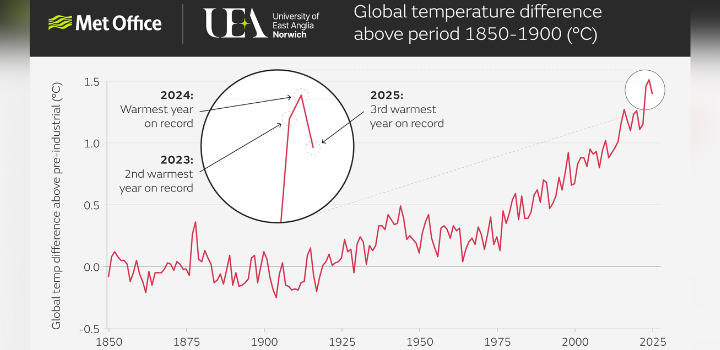
2025 continues series of world’s three warmest years
2025 is the third warmest year on record in a series from 1850, following 2024 and 2023, according to new data released today.
Read more