Survival of the smallest – why tiny creatures outlived dinosaurs
By: Communications
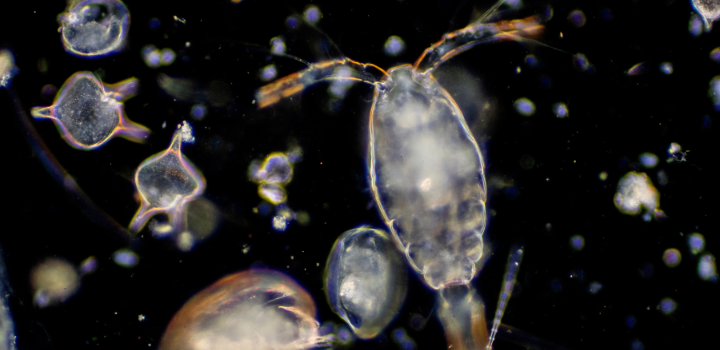
A University of East Anglia researcher has helped uncover why some marine life survived the mass extinction event that wiped out the dinosaurs.
Scientists have shown that tiny marine organisms in polar oceans persisted because they needed less energy and were more tolerant to darkness.
Published in the journal Nature, the study resolves a longstanding evolutionary mystery by identifying the factors that determined which marine species would survive - 66 million years ago.
Their small size and an ability to cope with darkness emerged as the key advantages.
Study lead author Dr Rui Ying, from UEA’s School of Environmental Sciences, said: “It’s an exciting breakthrough.
“For so many years, scientists have been unable to test what actually decided whether a species prevailed or perished because the extinction event involves multiple environmental changes like ocean acidification and darkness.”
“It is difficult to understand the causality because of the lack of fossil data and environmental proxy data, especially at century timescale.
“Using a numerical model, I looked at the base of the food chain – plankton – which helped us to identify the most likely cause and the best survival strategies for plankton.”
What happened 66 million years ago?
The Cretaceous–Paleogene (K–Pg) boundary is an ancient and much-studied geological signature marking the mass extinction that wiped out non-avian dinosaurs, separating the Mesozoic Era (the age of reptiles) from the Cenozoic Era (the age of mammals).
It is thought that the impact of an asteroid, called Chicxulub, caused the extinction of around 75 per cent of species in the fossil record by triggering catastrophic environmental changes.
Despite decades of research, the mechanisms linking the environmental changes to the selective extinction patterns observed in the fossil record have until now been unresolved.
But by creating and deploying a unique model which maps ecosystem traits globally, the scientists have been able to establish what attributes resulted in the marine plankton community’s survival.
Dr Ying, who carried out the research while at the University of Bristol, said: “The model is based on trades and the trade-off of how often they are eaten by predators and what they can eat against specific attributes, such as temperature, light level and body size.”
Why size matters
Study co-author Dr Fanny Monteiro, Associate Professor in Ocean Sciences at the University of Bristol, said: “The body size and abundance of small plankton mean the organisms rely on less energy, increasing their likelihood of survival.
“An ability to deal with lower light and darkness and turbulent waters in higher latitudes also makes them more adaptable to polar regions. In contrast, species adapted to higher light and warmer waters were more vulnerable to this type of mass extinction.”
Modelling millions of organisms
The model allowed the traits of millions of organisms to be analysed and quantified with unprecedented accuracy, providing important insights into the physical and chemical changes linked to diversity.
Besides shining a light on the distant past of marine life, the research can also help inform forecasts of how ecosystems might respond in future.
Study co-author Prof Daniela Schmidt at the University of Bristol said: “This study not only demonstrates how trait-based models can help us better understand biodiversity crises in ancient history, but it also has potential to indicate how less light and hotter environments, as a result of global warming, might impact current and future ecosystems.”
The research was funded by China Scholarship Council (CSC)-Bristol PhD Scholarship and NERC grants.
‘Darkness and body size shaped end-Cretaceous marine extinction patterns’ is published in the journal Nature.
Related Articles

OpenAI model halt is responsible move, UEA expert says
Halting the roll out of Open AI’s new model over safety concerns is the “ethical and responsible” thing to do – according to an expert in artificial intelligence at the University of East Anglia.
Read more
UEA subjects among UK best in student-focused league tables
The University of East Anglia has climbed to the top of a new league table for a variety of subjects – with Norwich named the nation's leading university city.
Read more
UEA among global elite for research collaboration
The University of East Anglia has been recognised as one of the best in the world for research collaboration in a major new ranking.
Read more