Researchers warn against securitised response to global biodiversity loss
By: Communications
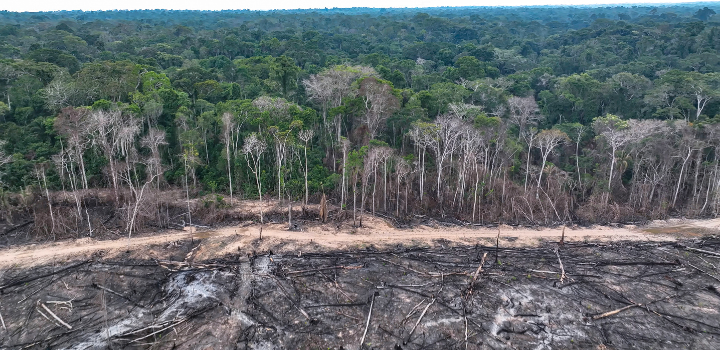
Scientists have warned that a new UK Government report on global biodiversity loss and national security risks distorting evidence and driving ineffective policy by framing ecological degradation and its impacts on migration as a security threat.
The report, ‘Global biodiversity loss, ecosystem collapse and national security’, was published in early 2026 and argues that accelerating biodiversity loss and ecosystem collapse pose mounting security threats to the UK.
Writing in the journal PLOS Climate, researchers from the University of East Anglia (UEA) and University of Exeter welcome the attention on biodiversity and nature loss. However, they say the report which views environmental change and biodiversity loss - alongside climate impacts - through a national security lens, could lead to poorly targeted actions and policy.
Past attempts to cast climate issues as security risks often relied on simplified causal claims, shifting authority towards military and border agencies in policymaking, and ultimately failed to motivate constructive climate action.
Instead, they sometimes triggered political backlash or restrictive migration policies. The researchers warn this strategy risks repeating the problems associated with the securitisation of climate change.
Attempting to galvanise action by framing any environmental issue as a security threat to elicit positive action creates its own risks, relying on “ethically questionable foundations” and is often based on overly simplified evidence.
Concerns over migration claims
The researchers highlight migration as a major weakness in the report’s analysis, arguing the evidence does not support claims that biodiversity loss will drive large-scale international migration towards the UK.
Decades of empirical research show that most environmentally-linked migration is short distance, occurring within countries or neighbouring regions - not across continents.
Dr Mark Tebboth, of UEA’s School of Global Development and lead author of the opinion article, said: “Biodiversity loss and ecosystem collapse are rightly recognised as serious global risks and the UK Government report raises an important and timely issue around the security implications of accelerating ecological degradation.
“However, it fails to present a credible causal link between biodiversity loss and UK-bound migration. Environmentally-linked migration is translated directly into security impacts for the UK, but current evidence does not support this assumption.
“Conflating environmental stress with national security risks leads to speculative conclusions, distracts from real threats, and misdirects resources.”
The researchers say the report also overstates the evidence by promoting a poorly sourced and mischaracterised claim that a 1 per cent rise in food insecurity leads to a 1.9 per cent rise in migration.
That figure originates from a non-peer-reviewed report based on a 2017 World Food Programme study - and the original study examined refugee flows from armed conflict, not general migration or biodiversity loss. Applying it to broad future migration trends is, the researchers say, “inappropriate”.
Security lens risks narrowing responses
“Positive actions to build resilience include supporting farmers to avoid food insecurity through food production harmonious with nature; avoiding urban development on flood plains to make space for water and nature; and accelerating climate action to avoid the consequences of runaway climate change,” said Dr Tebboth, Associate Professor in Environment and Global Development.
“But securitising biodiversity loss creates a policy environment where certain voices within government such defence and border agencies can disproportionately shape government responses. This sidelines institutions better suited to address ecological decline, food system fragility, and community resilience.”
The authors also caution that security-driven narratives tend to produce worst case scenarios such as mass displacement - scenarios not supported by current evidence.
Overemphasising such risks can obscure the most significant, and empirically grounded, risks to the UK associated with biodiversity loss, including the erosion of livelihoods and food systems, governance pressures in environmentally-stressed regions, and the growing vulnerability of populations who may be unable to move or adapt.
Call for evidence-based, non-securitised policy
The team warns that unfounded claims about mass displacement risk distorting the national debate and could push the UK towards counterproductive policy decisions.
“While biodiversity loss and ecosystem collapse are indeed major global threats, we argue the UK must ground its national risk assessments in rigorous evidence rather than deterministic models or speculative migration projections,” said Dr Tebboth.
“Policy should focus on protecting and restoring ecosystems critical to food security, supporting governance and adaptive capacity in vulnerable regions, and investing in early warning systems that track livelihood and ecological stress. They should avoid unfounded claims about mass displacement triggered by biodiversity decline.”
‘Risks and limits from a securitisation framing of nature and biodiversity crises: Lessons from climate change’, Mark Tebboth, Sarah Redicker, Neil Adger, Reetika Revathy Subramanian, is published in PLOS Climate on April 8.
Related Articles

More – not less – science needed to protect our planet
A leading climate researcher from the University of East Anglia has said it is time to “call out” deliberate efforts to undermine science and scientists.
Read more
New analysis of climate threats to biodiversity will help conservationists plan for future
Scientists have published the most comprehensive assessment to date of how climate change threatens biodiversity in more than 98,000 protected areas worldwide, aiming to help conservationists build resilience in the face of accelerating climate impacts.
Read more
Land-intensive carbon removal needs better siting to protect biodiversity
Significant reliance on land-based methods of carbon dioxide removal can protect biodiversity by avoiding climate impacts - but it could also compete with biodiversity protection unless there is better site selection, according to a new study.
Read more