First students arrive in Nanjing to study UEA degrees in digital creativity
By: Communications
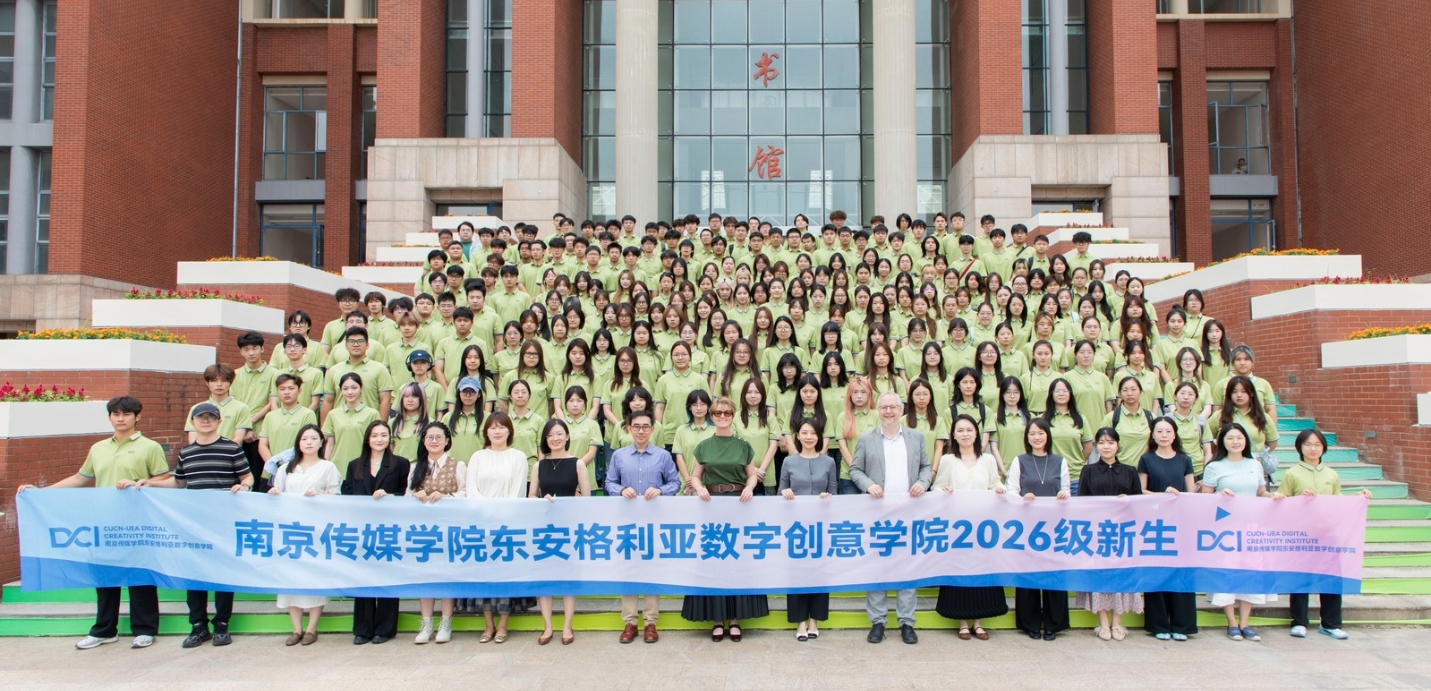
More than 200 students have joined the newly launched CUCN-UEA Digital Creativity Institute in Nanjing – marking UEA's largest transnational partnership to date.
The Institute is a landmark partnership between the University of East Anglia (UEA) and Communication University of China, Nanjing (CUCN), aimed at preparing graduates for the rapidly evolving global creative industries.
Bringing together the interdisciplinary study of media, film, digital communications, creative technologies, artificial intelligence and computing, the Institute aims to equip students with the skills to harness emerging technologies responsibly – to become the next generation of filmmakers, content strategists, games designers and digital media leaders.
Prof Steven McGuire, Senior Pro-Vice Chancellor and Deputy Vice-Chancellor (International) at UEA, said: "The launch of this Joint Education Institute represents a significant milestone in UEA’s relationship with the Communication University of China, Nanjing.
"The strong student recruitment we have seen is testimony to the quality of the education offered at both institutions."
The Institute was approved by China's Ministry of Education in December 2025 and represents UEA's largest and most ambitious transnational educational venture to date.
Students will benefit from a carefully co-designed curriculum, which emphasises the educational strengths of both UEA and CUCN.
Prof Catherine Richardson, Pro-Vice-Chancellor of the Faculty of Arts and Humanities, attended the opening ceremony for the new Institute in Nanjing this week. Her address to more than 200 students and faculty members emphasised the significance of the collaboration for UEA and for creative industries education globally.
She said: "This JEI gives us the opportunity to combine our considerable strengths as institutions.
"The CUCN approach, oriented to industry and focused on employment outcomes, is a vital one in this rapidly-changing global industry, and our students will benefit from its combination with UEA’s strong creative and critical work – home of the storytelling skills that underpin the way our creative industries communicate across the world."
Dr Thomas Roebuck, Associate Dean for Portfolio, Recruitment and Internationalisation for the Faculty of Arts and Humanities, who led the establishment of the Institute, also attended the opening ceremony.
He commented: "It is a joyous moment to see our new students assembled at the start of this remarkable educational journey, and the culmination of years of work by colleagues across UEA and CUCN.
"Our Institute's students have travelled from across China to study with us. We are grateful to the students and families who have put their trust in us to deliver a transformative educational experience.
"They are already demonstrating an ambition to tell stories that resonate across cultures and national boundaries. They recognise the importance of mastering new technologies, but also of channelling the human experiences, voices and values that give those technologies meaning.
"We firmly believe that the Institute's unique combination of British and Chinese higher education will empower our students to achieve those goals, preparing them to create stories that make sense of our fast-changing world and positioning them as creative leaders of tomorrow."
The Institute takes students who have been successful in China's Gaokao undergraduate entrance exam, studying across four-year degree programmes.
They will be taught in China and receive a double degree, from UEA and CUCN respectively, all delivered in country – with the opportunity to spend a year studying at UEA.
Related Articles
Groundbreaking new partnership to deliver digital creativity degrees in China
A new partnership between UEA and Communication University of China, Nanjing (CUCN) has been approved by China’s Ministry of Education, aiming to empower a new generation of globally-minded storytellers and digital creatives.
Read more
How dismissed symptoms can push patients to breaking point
Patients have been left feeling suicidal after feeling like their doctor was saying their symptoms were ‘all in their head’ – according to research from the University of East Anglia and the University of Cambridge.
Read more
New leadership appointment strengthens UEA's largest transnational education partnership
The University of East Anglia (UEA) will welcome a new Deputy Dean to its CUCN-UEA Digital Creativity Institute, to support the continued growth and success of its educational partnership in Nanjing, China.
Read more