Call for policy makers to protect pollinators
By: News Archive
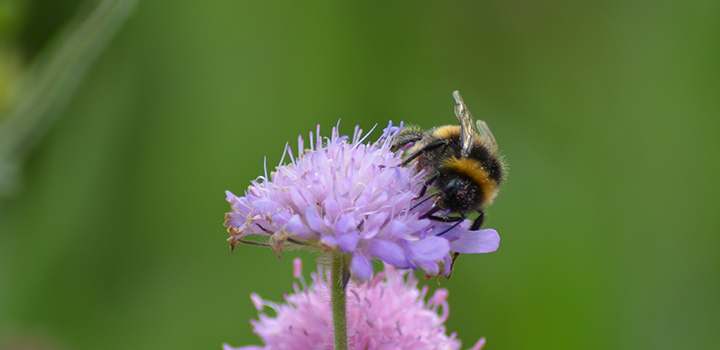
Pollinating insects could thrive if improvements are made to agri-environment schemes across Europe, according to new research involving the University of East Anglia.
More than 20 pollinator experts from 18 different countries looked at a range of wildlife habitats on farmland – called Ecological Focus Areas (EFAs) – to determine how well they support insect pollinators such as bumblebees, solitary bees and hoverflies.
Despite significant investment in EFAs, the study found they are failing to provide all the resources insect pollinators require.
With more than 70 per cent of crops worldwide relying on insect pollinators, it highlights the need to create a variety of interconnected, well-managed habitats that complement each other in the resources they offer.
A decline in the number of insect pollinators has been attributed to intensive farming and the associated loss of flower-rich habitats which provide food, nesting and breeding sites.
Dr Lynn Dicks, from UEA’s School of Biological Sciences, said: “Farmed landscapes can support diverse communities of wild pollinators, if they provide suitable resources for each different type of pollinating insect.
“Flowers of the right shape and size have to be available throughout their adult life, and different pollinating insects have different needs for raising their young. Some hoverflies need wet ditches and ponds, for example, while many bee species find nesting sites in woody scrub or hedgerows.”
In a bid to decrease the environmental impact of agriculture, the 2014 EU Common Agricultural Policy (CAP) defined a set of habitat and landscape features that farmers needed to incorporate in order to receive basic farm payments.
The research was led by Scotland’s Rural College (SRUC), which joined forces with 22 pollinator experts from across Europe to evaluate how different EFA options varied in their potential to support insect pollinators – under both standard and pollinator-friendly management, as well as the extent of farmer uptake.
They identified substantial opportunities to improve the quality of agri-environmental habitats by implementing pollinator-friendly management practices. These would not only increase the abundance of resources in a habitat, but also the range of resources.
The findings of the study, which was funded under the Cost Action Super-B – Sustainable Pollination in Europe programme, will be used to inform the CAP post-2020.
Lead researcher Dr Lorna Cole, an agricultural ecologist at SRUC, said: “With the CAP post-2020 fast approaching, our study highlights that to effectively conserve pollinators, we need to improve habitat quality. With different habitats offering different resources we also need to focus on increasing habitat diversity to ensure that our countryside provides the range of resources that pollinators require.”
‘A critical analysis of the potential for EU Common Agricultural Policy measures to support wild pollinators on farmland’ is published in the Journal of Applied Ecology on February 17, 2020.
Related Articles

Six UEA professors named in Highly Cited Researchers 2023 list
Six UEA professors have been named in the annual Highly Cited Researchers list for 2023, which celebrates some of the most influential researchers in the world today.
Read more
Investigating the coolest climate gas youve never heard of
Researchers at the University of East Anglia have launched a new project to investigate how a climate-cooling gas is produced in agriculture.
Read more
Time restricted fasting could cause fertility problems
Time-restricted fasting diets could cause fertility problems according to new research from the University of East Anglia.
Read more