Antarctic sea ice packed with climate cooling compounds
By: Communications
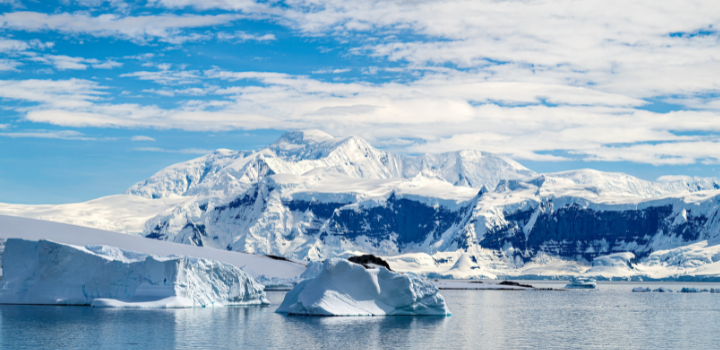
Antarctica’s frozen seas are churning out chemicals that could help cool the planet – according to new research from the University of East Anglia.
A new study reveals that sea ice in the Southern Ocean contains dramatically higher levels of a key compound linked to climate regulation than the surrounding waters.
But as climate change continues to shrink and thin polar ice, the balance of this chemical factory could change – with unknown consequences.
In collaboration with the University of Pretoria and Stellenbosch University in South Africa, scientists studied a chemical called dimethylsulfoniopropionate (DMSP) – which plays a crucial role in cooling the planet.
Produced by microscopic marine organisms such as algae and bacteria, this chemical helps them survive the punishing cold and salty conditions of polar ice.
But it also has a second function. When it breaks down, it releases gases that can seed clouds and reflect sunlight – effectively helping to cool the Earth.
The new study shows that Antarctic sea ice contains up to 38 times more of this key compound than surrounding waters.
Prof Jonathan Todd, from UEA’s School of Biological Sciences and the Quadram Institute on the Norwich Research Park, said: “Because the gases released from DMSP can contribute to cloud formation, they help reflect sunlight and in effect cool the surface below. In other words, sea ice formation and melting could be quietly helping to moderate global temperatures.
“Understanding these processes is vital if scientists are to predict how the planet will respond to future warming.”
How the research happened
The team studied a natural chemical in the ocean called DMSP which is made by tiny marine organisms.
They analysed samples collected during a winter expedition to the Southern Ocean and found DMSP concentrations in sea ice ranging from 24 to 115 nanomoles – far higher than the three to 11 nanomoles typically seen in seawater.
Co-author Dr Libby Hanwell, also from UEA’s School of Biological Sciences, said: “Clearly, there is a lot of very important microbes cycling sulfur compounds in the Southern Ocean around Antarctica, especially in sea ice, which potentially impacts us all.
A frozen ‘chemical reservoir’
Dr Hanwell said: “The ice isn’t just frozen water – it’s a dense, dynamic reservoir of climate-cooling chemicals. It’s acting like a storage reservoir for DMSP.”
Inside the ice, microscopic algae ramp up production of DMSP to help them survive the harsh polar conditions.
The study found that algae are likely the main producers of DMSP, thanks to specific genes that drive its creation. But the team also identified a surprisingly diverse cast of bacteria contributing to both its production and breakdown.
An unseen ecosystem at work
Prof Todd said: “Far from being barren, Antarctic ice is bustling with microbial life – and these minuscule organisms are shaping the chemistry of the planet.
“The big worry is that as climate change causes the Arctic ice to melt, its capacity to help cool the Earth could also reduce – causing an inevitable acceleration in global warming.”
This work was funded by the EU’s Horizon 2020 research and innovation programme, the Natural Environmental Research Council (NERC), the Leverhulme Trust and the Biotechnology and Biological Sciences Research Council (BBSRC), among others.
‘Sea ice in polar regions stores large amounts of a climate-relevant chemical (DMSP), with algae and bacteria constantly producing and breaking it down - making it an important but understudied player in how the Earth’s climate is regulated’ is published in the journal Nature Communications.
Study Biological Sciences at UEA
Considering your options for September? Clearing is your chance to find the course that fits you.
Be ready for results day with the latest updates. Register for Clearing updates.
Related Articles

Sea ice plays important role in variability of carbon uptake by Southern Ocean
New research reveals the importance of winter sea ice in the year-to-year variability of the amount of atmospheric CO2 absorbed by a region of the Southern Ocean.
Read more
Underwater mapping reveals new insights into melting of Antarctica's ice shelves
Clues to future sea level rise have been revealed by the first detailed maps of the underside of a floating ice shelf in Antarctica.
Read more
Study identifies new cause of melting Antarctic ice shelves
Researchers have discovered a process that can contribute to the melting of ice shelves in the Antarctic.
Read more