The heart’s ‘natural bypass’ that could spare patients from risky procedures
By: Communications
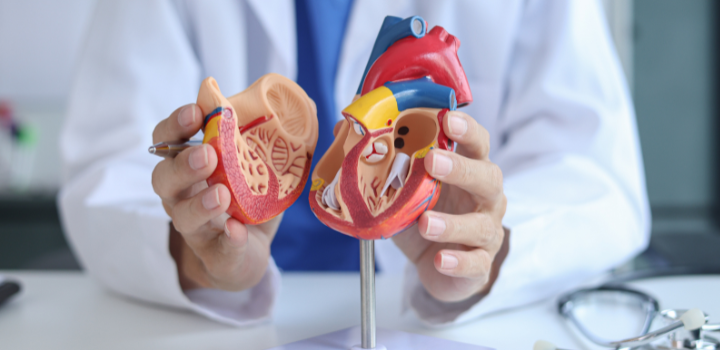
Your heart already has its own built-in bypass system that predicts whether the heart muscle is alive or dead - according to new research from the University of East Anglia and Norfolk and Norwich University Hospital.
A new study published today reveals how tiny hidden vessels could hold the key to deciding who really needs complex and risky surgery - and who doesn’t.
The team found that a simple angiogram scoring system could help identify patients whose heart muscle is still alive - even when a major artery has been completely blocked for months.
It is hoped that the breakthrough could change how cardiac patients are treated.
Lead researcher Dr Pankaj Garg, from UEA’s Norwich Medical School and a consultant cardiologist at the Norfolk and Norwich University Hospital, said: “When a coronary artery becomes fully blocked, many would assume the heart muscle beyond it simply dies.
“But that’s not always the case.
“In some patients, the body responds by growing tiny collateral blood vessels, effectively creating a natural detour around the blockage. These vessels quietly keep blood flowing, acting like an emergency backup system.
“We wanted to better understand how this could be used to decide on treatment."
How the research happened
Researchers analysed 56 patients with completely blocked arteries – known as chronic total occlusion.
The team compared a routine angiogram score (called the Rentrop score), which grades how well these collateral vessels are working - with advanced MRI scans, considered the gold standard for checking whether heart muscle is still alive or permanently damaged.
Dr Garg said: “Chronic total occlusion is common in people with coronary artery disease and is seen in about one-in-five patients with established coronary artery disease who undergo diagnostic angiography.
“We checked whether the heart muscle beyond the blocked artery was still alive, rather than permanently scarred.
“We found that when a coronary artery has been fully blocked for months, the heart's own natural bypass vessels can reveal whether the heart muscle beyond the blockage is still alive.
“Patients with stronger natural bypass vessels – a Rentrop score above one – were far more likely to still have living heart muscle, despite the blockage.
“Importantly, the Rentrop score was the only independent predictor of viability in the study.
“In fact, each step up in the score more than doubled the chances that the affected heart tissue was still alive.
“This means that the heart's own natural bypass vessels could help doctors decide which patients with a fully blocked artery may benefit from further scans or treatment.
Why this matters for patients
“Opening a completely blocked artery is no small matter,” said Dr Garg. “These procedures are long, complex, and resource-heavy, and not every patient benefits.
“We hope that our work could help doctors make faster, more informed decisions in the catheter laboratory, especially when advanced cardiac MRI is not immediately available.
“By simply looking at what’s already visible during a routine angiogram, doctors can quickly identify patients worth investigating further, prioritise MRI scans for those who need them most and avoid unnecessary procedures in patients unlikely to benefit.
“In other words, it could mean faster decisions, fewer risks, and better outcomes.”
A fully blocked artery no longer automatically spells disaster
Dr Garg said: “When doctors find a completely blocked coronary artery, one of the biggest questions is whether the heart muscle beyond that blockage it is still alive.
“This research suggests that the heart’s own natural bypass system can give us a valuable clue.
"They added that while MRI remains the gold standard, the angiogram-based score could act as a rapid, bedside indicator – especially in hospitals where access to advanced imaging is limited.
"This is about using information doctors already see during an angiogram more intelligently.
The better we can identify living heart muscle, the better we can tailor treatment to the right patient at the right time."
This study was led by UEA in collaboration with the Norfolk and Norwich University Hospitals NHS Foundation Trust and Leiden University Medical Centre.
‘Rentrop collateral grade predicts myocardial viability in chronic total occlusion on cardiac magnetic resonance’ is published in the journal Open Heart.
Related Articles

One in three NHS heart scans ‘fail’ but new research shows which patients are most at risk
Thousands of patients sent for vital heart scans may be undergoing unnecessary first-line tests that fail to deliver clear answers – according to new research from the University of East Anglia.
Read more
MRI scan breakthrough could spare thousands of heart patients from risky invasive tests
Doctors may soon be able to tell just how sick a heart failure patient really is by using a routine MRI scan, thanks to new research from the University of East Anglia (UEA).
Read more
Breakthrough heart MRI technique accurately predicts heart failure risk in general population
MRI scans could replace invasive heart tests, as new research shows they can reliably estimate pressures inside the heart to predict if a patient will develop heart failure.
Read more