Study reveals climatic fingerprints of wildfires and volcanic eruptions
By: Communications
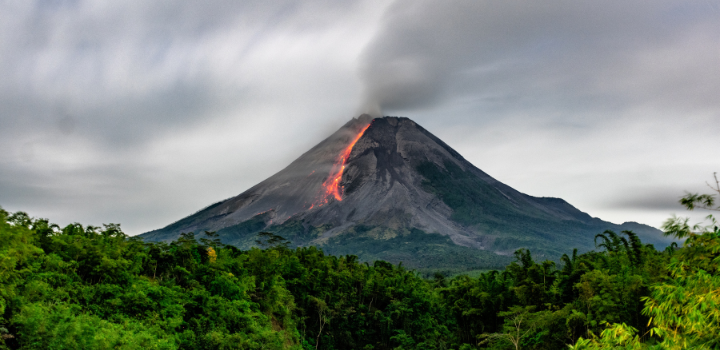
Scientists have shown how three major natural events impacted global atmospheric temperatures, in research that could help explain humans’ role in global warming.
Volcanoes and wildfires can inject millions of tons of gases and aerosol particles into the air, affecting temperatures on a global scale. But picking out the specific impact of individual events against a background of many contributing factors is difficult.
Now scientists from MIT and the University of East Anglia (UEA) have a way to quiet the ‘noise’ and identify the specific signal of wildfires and volcanic eruptions, including their effects on Earth’s global atmospheric temperatures.
In a study published this week in the Proceedings of the National Academy of Sciences, the researchers report that they detected statistically significant changes in global atmospheric temperatures in response to three major natural events: the eruption of Mount Pinatubo in 1991, the Australian wildfires in 2019-2020, and the eruption of the underwater volcano Hunga Tonga in the South Pacific in 2022.
While the specifics of each event differed, all three appeared to significantly affect temperatures in the stratosphere. The stratosphere lies above the troposphere, which is the lowest layer of the atmosphere, closest to the surface, where global warming has accelerated in recent years.
Pinatubo showed the classic pattern of stratospheric warming paired with tropospheric cooling. The Australian wildfires and the Hunga Tonga eruption also showed significant warming or cooling in the stratosphere, respectively, but they did not produce a robust, globally detectable tropospheric signal over the first two years following each event. This new understanding will help scientists further pin down the effect of human-related emissions on global temperature change.
“Understanding the climate responses to natural forcings is essential for us to interpret anthropogenic climate change,” said study author Dr Yaowei Li, currently a visiting scientist in MIT’s Department of Earth, Atmospheric and Planetary Sciences. “Unlike the global tropospheric and surface cooling caused by Pinatubo, our results also indicate that the Australian wildfires and Hunga Tonga eruption may not have played a role in the acceleration of global surface warming in recent years. So, there must be some other factors.”
The study’s co-authors include Prof Susan Solomon at MIT, Prof Benjamin Santer of UEA’s Climatic Research Unit, Prof David Thompson of UEA’s School of Environmental Sciences and Colorado State University, and Prof Qiang Fu of the University of Washington.
Prof Santer said: "It's great to compare and contrast, in a rigorous way, the temperature signals from three very different types of event – the surface eruption of Mount Pinatubo, the unusual underwater eruption of the Hunga Tonga volcano, and the large Australian wildfires of 2019 and 2020.
“All three events significantly affected Earth's atmospheric temperature. I hope other analysts will use this type of statistical framework for looking at the impacts of future volcanic eruptions and large wildfires."
Extraordinary events
The last few years have set back-to-back records for global average surface temperatures. The World Meteorological Organization recently confirmed that the years 2023 to 2025 were the three warmest years on record, while the past 11 years have been the 11 warmest years ever recorded. The world is warming, due mainly to human activities that have emitted huge amounts of greenhouse gases into the atmosphere over centuries.
In addition to greenhouse gases, the atmosphere has been on the receiving end of other large-scale emissions, including sulfur gases and water vapor from volcanic eruptions and smoke particles from wildfires. Dr Li and his colleagues wondered whether such natural events could have any global impact on temperatures, and whether such an effect would be detectable.
“These events are extraordinary and very unique in terms of the different materials they inject into different altitudes,” said Dr Li. “So we asked the question: Do these events actually perturb the global temperature to a degree that could be identifiable from natural, meteorological noise, and could they contribute to some of the exceptional global surface warming we’ve seen in the last few years?”
In particular, the team looked for signals of global temperature change in response to three large-scale natural events. The Pinatubo eruption resulted in around 20 million tons of volcanic aerosols in the stratosphere, which was the largest volume ever recorded by modern satellite instruments.
The Australian fires injected around 1 million tons of smoke particles into the upper troposphere and stratosphere. And the Hunga Tonga eruption produced the largest atmospheric explosion on satellite record, launching nearly 150 million tons of water vapor into the stratosphere.
If any natural event could measurably shift global temperatures, the team reasoned, it would be any of these three.
Natural signals
For this study, the team took a signal-to-noise approach. They looked to minimize ‘noise’ from other known influences on global temperatures in order to isolate the ‘signal’, such as a change in temperature associated specifically with one of the three natural events.
To do so, they looked first through satellite measurements taken by the Stratospheric Sounding Unit (SSU) and the Microwave and Advanced Microwave Sounding Units (MSU), which have been measuring global temperatures at different altitudes throughout the atmosphere since 1979.
The team compiled SSU and MSU measurements from 1986 to the present day. From these, the researchers could see long-term trends of steady tropospheric warming and stratospheric cooling. Those long-term trends are largely associated with anthropogenic greenhouse gases, which the team subtracted from the dataset.
What was left over was more of a level baseline, which still contained some confounding noise, in the form of natural variability. Global temperature changes can also be affected by phenomena such as El Niño and La Niña, which naturally warm and cool the Earth every few years. The sun also swings global temperatures on a roughly 11-year cycle. The team took this natural variability into account and subtracted out the effects of these influences.
After minimizing such noise from their dataset, the team reasoned that whatever temperature changes remained could be more easily traced to the three large-scale natural events and quantified. And indeed, when they pinned the events to the temperature measurements, at the times that they occurred, they could clearly see how each event influenced temperatures around the world.
The team found that Pinatubo decreased global tropospheric temperatures by up to about 0.7 degree Celsius, for more than two years following the eruption. The volcanic sulfate aerosols essentially acted as many tiny reflectors, cooling the troposphere and surface by scattering sunlight back into space. At the same time, the aerosols, which remained in the stratosphere, also absorbed heat that was emitted from the surface, subsequently warming the stratosphere.
This finding agreed with many other studies of the event, which confirmed that the team’s approach is accurate. They applied the same method to the 2019-2020 Australian wildfires, and the 2022 underwater eruption — events where the influence on global temperatures is less clear.
For the Australian wildfires, they found that the smoke particles caused the global stratosphere to warm up, by up to about 0.77 degree Celsius, which persisted for about five months but did not produce a clear global tropospheric signal.
“In the end we found that the wildfire smoke caused a very strong warming in the stratosphere, because these materials are very different chemically from sulfate,” explained Dr Li. “They are particles that are dark coloured, meaning they are efficient at absorbing solar radiation. So, a relatively small amount of smoke particles can cause a dramatic warming.”
In the case of the Hunga Tonga, the underwater eruption triggered a global cooling effect in the middle-to-upper stratosphere, of up to about half a degree Celsius, lasting for several years.
“The Australian fires and the Hunga Tonga really packed a punch at stratospheric altitudes, and this study shows for the first time how to quantify how strong that punch was. I find their impact up high quite remarkable,” said Prof Solomon. “But the ongoing issue is why the last several years have been so warm lower down, in the troposphere - ruling out those natural events points even more strongly at human influences.”
Related Articles
Rising simultaneous wildfire risk compromises international firefighting efforts
The most high-risk conditions for fires are increasingly happening across countries at the same time, making resulting wildfires even more challenging to tackle, new research reveals.
Read more
Climate change drove extreme wildfire seasons across the Americas, making burned areas around 30 times larger
Human-driven climate change made wildfires in parts of South America and Southern California many times larger and more destructive, according to an annual assessment by international experts.
Read more
Volcano cliffs can affect monitoring data, study finds
New research led by the University of East Anglia (UEA) reveals that sharp variations of the surface of volcanoes can affect data collected by monitoring equipment.
Read more