Norfolk's social supermarkets provide national blueprint
By: Communications
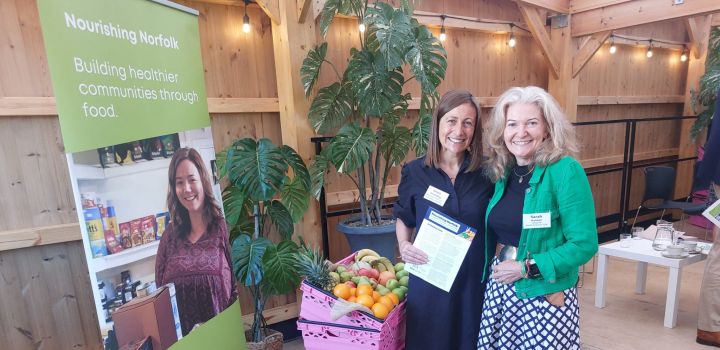
A pioneering new report by University of East Anglia researchers has revealed that Norfolk is leading the way in helping people who are struggling to make ends meet, providing a blueprint for other areas seeking to do the same.
The Nourishing Norfolk programme, run by Norfolk Community Foundation, has created the UK’s first network of affordable food hubs with its own central warehouse. These are not food banks, but local shops where people can choose affordable groceries and also find friendly advice and support with wider challenges they are facing.
Delivering huge benefits for Norfolk
The evaluation, carried out by UEA and supported by the National Institute for Health and Care Research (NIHR) Applied Research Collaboration (ARC) East of England, found that the programme is delivering huge benefits for Norfolk.
For every £1 put in, it creates £6.54 in social value, by improving health, easing money worries, and strengthening community life. It is the first time a scheme like this in the UK has been tested so thoroughly, setting a new benchmark nationally.
The findings were explored at a summit on Friday 12 September at the Norfolk Food Hall, hosted by the Royal Norfolk Agricultural Association. A panel of experts, including representatives from UEA, local food hubs, and local company Norse Group, discussed how the model is making a big difference here and could inspire change across the UK.
The report shows that since its launch in 2020, Nourishing Norfolk has helped more than 40,000 people across 15,000 households in 30 communities.
Its supermarket-style hubs provide affordable food with dignity and choice, while also offering support to address wider challenges such as loneliness, health, and employment, alongside support that addresses wider challenges such as loneliness, health, and employment.
The report also shows that:
- People saved on average 50% on their weekly shop.
- 75% reported less worry about money.
- More than half of shoppers said they felt less lonely.
- 70% said their children were eating more healthily.
Dr Sarah Hanson, Associate Professor in Community Health in the School of Health Sciences, who led the evaluation, said:
“Our evaluation of the Nourishing programme has shown once again the power of connected communities. Not only did we find people accessing nutritious food at a price they could afford, we also found in accessing this people were also getting support for wider life challenges.
“These trusted spaces, with support that ranges from encouraging conversations, to noticing abuse to direct signposting to services enables communities to thrive and for people to feel empowered to make life changes to support their wider health and wellbeing. For many, their social supermarket (The Cabin, The Pantry, The Shelf etc.) has replaced the post office and village shop and the connection these brought in the past.”
Dr Hanson worked on the evaluation alongside Anna Sweeting, a research fellow at Norwich Medical School.
Claire Mackintosh MBE, CEO of Norfolk Community Foundation, said: “This report confirms what we have seen every day: Nourishing Norfolk is transforming lives. By putting food at the centre but building out to tackle the wider issues that keep people in poverty, this programme is creating stronger, healthier, more connected communities.”
Andrew Forsey, CEO of Feeding Britain, added: “As the UK looks to move away from dependence on food banks, this report offers both a map and a compass. Norfolk has shown that by empowering people with choice and dignity, food hubs can transform lives and communities.”
Norfolk's 26 social supermarkets
The Nourishing Norfolk network now includes 26 social supermarkets across the county, serving coastal towns, rural villages and city neighbourhoods. The summit on 12 September brought together local and national partners to explore how the model can be expanded and replicated.
The success of Nourishing Norfolk has also been made possible through the support of local partners, including Norse Group.
By providing expertise in logistics and distribution, Norse helped establish the central warehouse system that now supplies hubs across the county. This has helped ease pressure on volunteers and hub leaders, ensuring shelves stay stocked and allowing local teams to focus on supporting their communities.
The report also identified how Norfolk Community Foundation worked alongside communities to help them. It showed the Foundation was able to find and convene the right mix of funders and support to get the programme off the ground faster than any one organisation alone could.
It also trusted local charities to act, allowing them to lead decisions from the front and enabling them to take action that made sense in their community.
Case study
Amanda* is in her mid 60s. She had worked for many years in a senior role in the public sector supporting vulnerable people. After being part of many restructures, she decided to take early retirement.
Soon afterwards, the cost-of-living crisis hit with the war in Ukraine and rising utility and food prices, and suddenly her fixed income did not meet her outgoings.
Panic set in as she struggled to see how she could manage until her state pension started and she didn’t qualify for any state support.
Her heating was turned off, and she had several months when she hadn’t eaten a proper meal. She also needs to eat gluten free products which are more expensive. She took a friend to the food hub, based in a small market town.
She said: “I didn’t think it was for people like me, I didn’t think it was right to be using it.”
The second time she took her friend, she said: “I thought, get over yourself and then it was amazing the support I got. They always point me to gluten free products that I might have missed and the vegetables are really important to me.”
She said of her experience: “This has really wobbled me as I have always been independent and self-reliant and now it is tough. I have worked for over 40 years and how can you have done that and be my age and you can’t put the heating or hot water on.
"The more I have come, the more I feel greeted like a long lost friend. There is no judgement.
"For me, life is a series of hurdles that you have to find a solution to. This is the solution to my current situation. It is very important to me to have a sense of control over my life and this place has given me a solution and has helped my sense of wellbeing so that I can manage other parts of my life.”
*Alias
Related Articles

Thousands of heart patients could avoid permanent stents
Thousands of heart patients could be treated without having a metal stent permanently implanted in their arteries - according to research from the University of East Anglia.
Read more
Stark male-female differences revealed in autoimmune diseases misdiagnosed as mental health conditions
Females with autoimmune diseases are more likely than males to report mental health misdiagnoses and face longer diagnostic delays, University of East Anglia and Cambridge research has found.
Read more
UEA subjects among UK best in student-focused league tables
The University of East Anglia has climbed to the top of a new league table for a variety of subjects – with Norwich named the nation's leading university city.
Read more