Leading climate research centre celebrates 25th anniversary
By: Communications
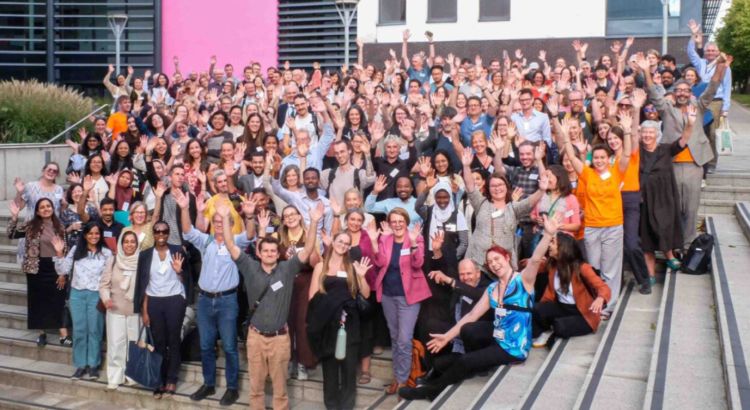
Twenty-five years of leading climate research for policy was celebrated at the University of East Anglia with a major conference that addressed the opportunities and challenges for climate action now, not the distant future.
Involving 300 researchers from 20 countries, the event last week was organised by the Tyndall Centre for Climate Change Research, which has its headquarters at UEA and is the UK’s first interdisciplinary centres of excellence for the study of climate change, its impacts, and policy responses.
The three-day conference - ‘Our Critical Decade for Climate Action’ - built on the Tyndall Centre’s legacy to bring together the latest interdisciplinary science, spanning physical, social, and natural sciences and the arts and humanities, to generate new knowledge and strengthen the foundations for a healthy planet and fair society.
It also featured posters from 100 early-career researchers at the Sainsbury Centre, and an evening celebration attended by 400 climate professionals, hosted by Climate Museum UK.
Asher Minns, Executive Director at the Tyndall Centre, said: "Not only was this conference our largest one in Norwich, but it was also our most important to date.
"Climate change is an all-encompassing issue that we cannot ignore, waste time being inactive or argue about.
"For those of us who’ve been around since the start of the Tyndall Centre, this is our critical decade for climate action, it’s what we’ve been working for…For the younger researchers, their critical decades for climate action are yet to come.
"We cannot wait or deliberate because we are already missing our chance to protect this region and our planet’s future. The co-benefits of climate action are considerable”
Established in 2000 by UEA, the Tyndall Centre is a partnership of universities, bringing together researchers from the social and natural sciences, with engineering, to develop sustainable responses to climate change.
The conference addressed four research themes: the emergent and urgent transitions needed in this ‘critical’ decade; aligning climate action with Paris commitments; understanding the barriers and enablers to delivering climate action at scale; and how to build and sustain coalitions for climate action.
Among those taking part were researchers from UK Universities, Europe, Africa and Asia, including members of the UK and French Climate Change Committees.
Following on from the conference a collection of Briefing Notes and peer-reviewed publications for the journal Climate Resilience and Sustainability will be produced.
There is also a display in the UEA library about the history of climate research at the university, from the Climatic Research Unit to the Tyndall Centre, while contemporary artist and Leverhulme Doctoral Scholar, Erik Hartin, has an installation entitled ‘Octopus Container’ outside the Sainsbury Centre.
Related Articles
New climate report finds time running out to save the Fens
New research highlights the threat to one of the UK’s most vital agricultural and ecological regions from climate change floods, droughts and biodiversity collapse.
Read more
A third of China’s urban population at risk of city sinking, new satellite data shows
Land subsidence is overlooked as a hazard in cities, according to scientists from the University of East Anglia (UEA) and Virginia Tech.
Read more
£2m will support climate education engagement in schools
Schools and colleges across the East of England will be able to learn about climate change, energy and biodiversity from a new climate education hub.
Read more