Illuminating pain with ultrafast spectroscopy
By: Communications
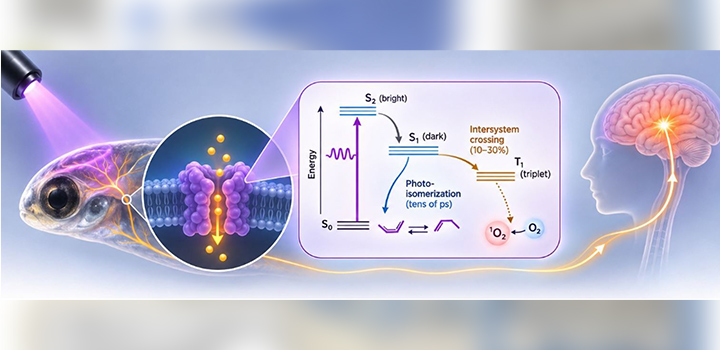
A new study undertaken by the Bull Research Group within UEA's School of Chemistry, Pharmacy and Pharmacology has uncovered the fundamental photochemistry behind optovin's behaviour.
Understanding optopharmacology
The ability to control biological processes using light offers promising possibilities for medicine.
One approach, known as optopharmacology, uses light-sensitive molecules to switch the activity of proteins on or off, potentially allowing drugs to act precisely where and when they are needed.
A notable example is optovin, a molecule that responds to violet light by activating TRPA1, a protein involved in sensing pain.
Unlike optogenetics, which requires genetic modification of the host, optopharmacology offers the prospect of controlling naturally-occurring proteins using just light. Despite optovin's remarkable properties, exactly what happens within the molecule when it absorbs light has remained a mystery.
New study captures molecular behaviour in real time
Using photochemistry and ultrafast laser spectroscopy, drawing on world-leading facilities at UEA, researchers from the Bull Research Group – led by Dr James Bull – tracked the molecule's response to light on timescales of just trillionths of a second.
They discovered two competing pathways: most excited molecules rapidly change shape, while a smaller proportion enters a short-lived, chemically reactive state.
Published in the Journal of the American Chemical Society, the findings resolve the fundamental pathways through which optovin responds to light and lays a foundation for understanding its biological activity.
Looking ahead, this knowledge will help guide the development of a new generation of light-controlled molecules with improved efficiency and selectivity, opening possibilities for more precise control of biological processes and therapeutic applications.
Dr James Bull said: "By observing what happens to optovin on femtosecond to picosecond timescales – from quadrillionths to trillionths of a second – after it absorbs light, we can uncover the fundamental chemistry that makes it work.
"This understanding is essential for designing the next generation of light-controlled molecules, opening up exciting possibilities for developing new pharmaceuticals that can be activated precisely where and when they are needed."
Related Articles

Scientists discover surprising new way to control light
UEA scientists have uncovered a hidden property of light that allows it to twist, spin and behave differently – without mirrors, materials or special lenses.
Read more
Anti-aging drug Rapamycin extends lifespan as effectively as eating less
The anti-aging drug Rapamycin has the same life-extending effect as eating less, according to new research from UEA.
Read more
UEA produces England's most decorated early career pharmacists
UEA’s first graduates from the NQP-IP programme are the only pharmacists in England to gain triple recognition of the PGDip, Independent Prescriber, and RPS Credential, through an integrated programme redefining early career pharmacist training.
Read more