Humans show bat-like skills using mouth-click echolocation
By: Communications
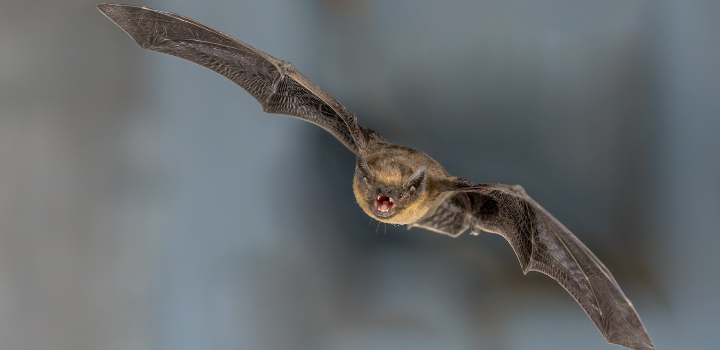
It may sound like a scene from Nosferatu, but research from UEA shows that humans can use bat-like echolocation skills to judge the distance of objects.
A study reveals that, just like bats navigating in the dark, humans too can rely on the echoes of mouth clicks to gauge how far away objects are.
While humans may not match the precision of these nocturnal navigators, the study shows that with simple tools like mouth clicks, we can tap into a surprisingly effective form of spatial awareness.
It is hoped that the findings could have implications for assistive technologies and training programs for visually impaired people.
Lead researcher Dr Andrew Kolarik, from UEA's School of Psychology, said: “We know that by producing sounds like tongue clicks, finger snaps or cane taps, and then listening back to the echoes that bounce back, humans can create a mental “picture” of their surroundings.
“This is especially important for people who are blind.
“The ability to judge the distance of objects accurately is important for safe navigation and spatial awareness. However, distance to sound sources is often underestimated, especially at larger distances.
“We wanted to better understand this phenomenon.”
How the research happened
The experiment involved 11 blindfolded participants who used mouth clicks to judge the distance of objects made of either aluminium or foam, with foam being less reflective to sound.
Just like bats navigating in the dark, participants relied on the echoes of their clicks to estimate how far away the objects were.
Dr Kolarik said: “After a bit of practicing, we got the participants to listen out for sound reflections to try and work out whether an object had been placed in front of them or not.
“They then practiced judging distance using echolocation, by clicking and listening to sound echoes for objects positioned at 15, 45, or 75 cm away.
“Finally, we really put them to the test by getting them to make clicks to estimate the distance of objects placed at various distances, without being given any feedback.”
An astonishing discovery
“We found that our participants were able to echolocate after just a short period of training, with quite a high degree of success!” said Dr Kolarik.
"But they consistently underestimated how far away things are, especially at greater distances. We also found that the material of the object affects estimates - with better, more consistent performance for reflective aluminium objects compared to foam objects.
“This work highlights the human brain’s ability to adapt and use novel sensory strategies, much like bats do naturally. While humans may not match the precision of bats, the study shows that with simple tools like mouth clicks, we can tap into a surprisingly effective form of spatial awareness.”
The team hope their findings could have implications for assistive technologies and training programs for visually impaired people, offering new ways to enhance spatial perception through echolocation.
“We hope that our work might benefit echolocation training by increasing awareness that objects that are further away tend to be judged to be closer, especially for less reflective objects,” added Dr Kolarik.
‘Compression may be a general tendency of auditory distance judgments: evidence from distance estimates using a novel echolocation skill’ is published in the journal Experimental Brain Research.
Related Articles

Why memories get fuzzier with age – and what replaces them
Research from the University of East Anglia shows how our memories change with age and why specific details associated with past events can fade over time.
Read more
TikTok content supports “illicit vape subculture” among teens
TikTok content normalises illegal vaping among young people – according to research from the University of East Anglia (UEA).
Read more
UEA to investigate impact of AI on children as part of £3 million project
Researchers at the University of East Anglia will investigate how AI influences children’s cognitive, social and emotional development as part of work commissioned by the Department for Education.
Read more