History professor strikes gold with remarkable Iron Age discovery
By: Communications
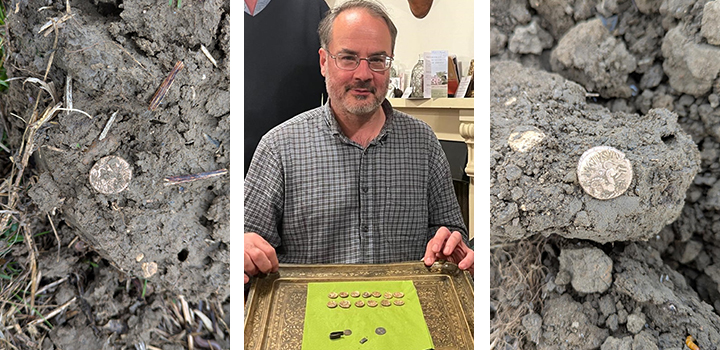
A history professor from the University of East Anglia has discovered the largest known hoard of Iron Age gold coins from the reign of King Dubnovellaunos.
Prof Tom Licence made the discovery, now known as the Bury St Edmunds Hoard, in a field near the Suffolk town in autumn 2024.
He first uncovered 17 full gold Iron Age coins and one quarter‑coin, followed by one more full coin when he returned a few months later – bringing the total to 18.
The hoard will be sold at auction by Noonans in London on Wednesday 4 March – with an expected value of £25,000.
Prof Licence hopes to use some of the proceeds to support local archaeological digs.
The Professor of Medieval History and Literature has been metal detecting since childhood, but the passion took hold when, as a teenager, he found a Charles I rose farthing in a flowerbed in Rye, East Sussex.
Prof Licence said: “The reason I went to this new field was because my niece was keen to go metal detecting. I noticed the field rose gently from a nearby stream and the soil was in perfect condition on a dry October day, so I decided to try my detector.”
Early signals led to pieces of Viking hack silver. Then came a gold coin. After marking out his search rows and adjusting his settings, he uncovered six more before sunset.
“I went into hunting mode,” he said. “Later that week, I found even more, so 17 coins in total.”
The coins were likely deposited during the reign of Dubnovellaunos, King of the Trinovantes, who ruled an area that encompassed parts of Essex and Hertfordshire from 25 BC to AD 10.
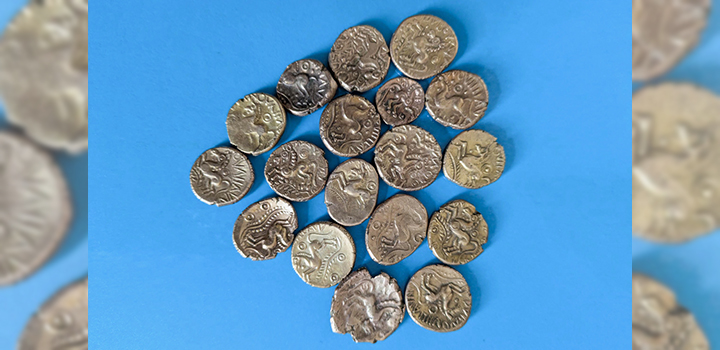
Image: The 18 gold coins of the Bury St Edmunds Hoard. Image credit: Prof Tom Licence
For Prof Licence, the find resonates on a personal level.
He said: “I was born in Essex, but my family has roots in the Bury St Edmunds area, and I like to imagine that the coins were buried by one of my ancestors.”
After finding the coins, he promptly reported the hoard to the Finds Liaison Officer.
Prof Licence and the landowner have chosen to keep one coin each, and he intends to use part of the proceeds from the remaining coins to support archaeological work in Suffolk.
A region steeped in archaeological discoveries
Prof Licence places his discovery firmly within East Anglia’s remarkable archaeological landscape: “East Anglia is rich in treasure. It’s the region that gave us Sutton Hoo, the Mildenhall dishes, and the great Iron Age torcs from Snettisham.
“Norfolk, each year, reports more treasure finds than anywhere else in the country, and Suffolk isn’t far behind.”
“Much of this history still lies undiscovered, and it turns up in unexpected places. You only have to scratch the surface, and something incredible sooner or later comes to light.”
In the latest figures for the Portable Antiquities Scheme, which covers 2024, Norfolk (7,120) and Suffolk (5,410), reported the most finds of an English county, with Norfolk’s 138 treasure discoveries also the country’s highest.
The student and the professor
Prof Licence’s discovery is not the first time a UEA figure has made a nationally significant find.
In 2014, UEA Landscape History student, Tom Lucking made national headlines when he unearthed the Winfarthing pendant in Norfolk – a gold and garnet piece found alongside a female grave dating to c. 630–650 AD.
In 2019, he discovered an 800-year-old sliver-gilt brooch near Wymondham.
More recently, he has worked on a dig near Thetford which uncovered two incredibly rare Iron Age objects in the same deposit – the most complete battle trumpet, or carnyx, ever found in Europe, and Europe’s first ever boar’s head standard, both of which featured on the BBC’s Digging for Britain.
Tom said: "History and archaeology is something I developed a passion for at a young age.
"Alongside my hobby of metal detecting giving me the privilege to make some exciting discoveries, studying History at UEA, from undergraduate through to PhD, helped me develop that further and begin to understand the landscape into which these objects were being lost or deposited and why people make these amazing discoveries in certain places.
"It also equipped me with the skills and knowledge to develop my career in professional archaeology, excavating sites in the region that future students will hopefully use in their own research."
Lucking, who began metal‑detecting at 11 has been celebrated for responsibly reporting finds, collaborating with archaeologists, and helping keep significant artefacts in East Anglian public collections.Related Articles

What new Game of Thrones prequel gets right about courage, honour, horsemanship and the power of bling
If Game of Thrones seems obsessed with bling, chivalry, honour and horsemanship – that’s because the real medieval world was too, according to the prequel's historical advisor Dr Hugh Doherty.
Read more
Harvard Law School’s ‘copy’ of Magna Carta revealed as original
Researchers at UEA and Kings College London have discovered that a ‘copy’ of Magna Carta owned by Harvard Law School is in fact a rare original from 1300.
Read more