Guide dogs in training visit UEA
By: Communications
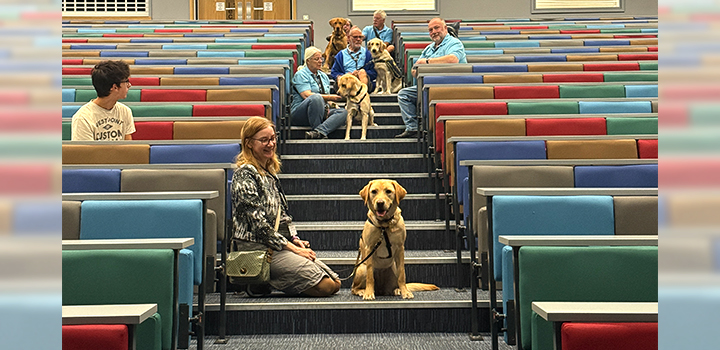
A group of seven puppies, destined for jobs as guide dogs, recently visited UEA’s campus alongside their volunteer Puppy Raisers, who look after them until they are just over a year old, and representatives from the national charity Guide Dogs, to experience a new environment and learn to cope with a range of distractions.
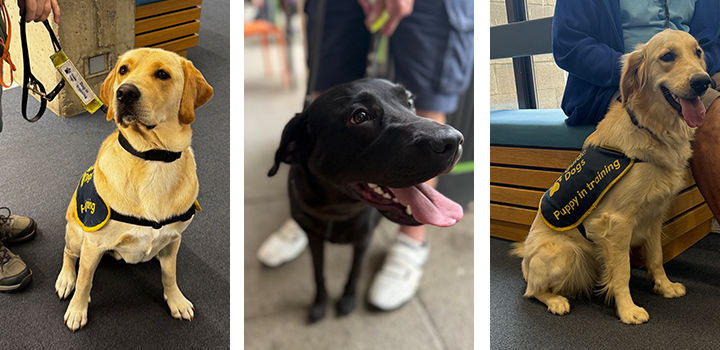
The puppies; Charlie, Verity, Karter, Maddie, Ascot, Charm and Fizz; ranged from around seven to 13 months, meaning they were at very different stages of their development, training, and bounciness!
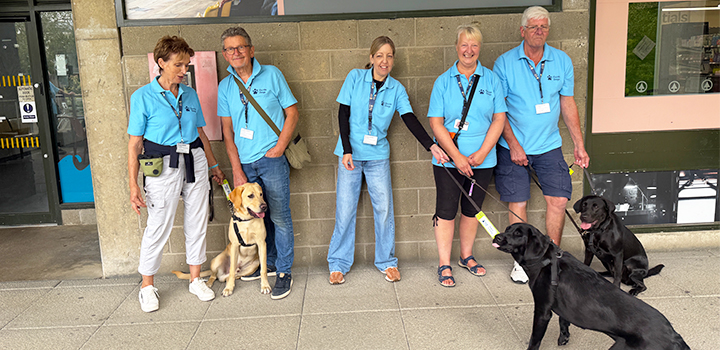
Formal guide dog training can take around six months, beginning when the dogs are around 14 months old, but even before this the puppies are gently exposed to different sights, sounds and situations, as well as learning to socialise with people and other animals.
During their visit to UEA, the puppies were walked around campus, both outside and in buildings, as well as riding in lifts and meeting staff and students.
Claire Pratt, Deputy Director for Student Journey & Support Services at UEA, said:
"It was great to welcome representatives from Guide Dogs and an array of their cute puppies to UEA for the very first time, giving the dogs a chance to experience new faces and places as part of their training.
"Guide dogs are such a vital support for so many people, including members of our own community, and we hope the time spent with us will play a part in their eventual development into fully trained assistance dogs."
Although a range of breeds (and cross-breeds) are routinely used as assistance dogs, common ones are Labrador Retrievers, Golden Retrievers, and German Shepherds, with around 60% of those trained and working actually Labrador x Golden Retrievers.
Fay McAllister, Puppy Development Advisor for Guide Dogs covering the local area, said:
"We’d like to say a big thank you to everyone at the University of East Anglia for supporting with this important training visit. As part of our vital training for our pups, we try to expose them to different environments, with a variety of sights and sounds.
"To support this, we organise days out for them, similar to school trips, where they can experience new places and learn how to behave well in these settings. Our visit to the University of East Anglia provided a great opportunity for our pups to explore a busy environment and has helped prepare them for their future role guiding someone with sight loss."
It costs £102,000 to take a dog from puppyhood to adulthood with all of the requisite training, including £25,000 to support the working partnership throughout their lives together.
Although it depends on the dog, typically a guide dog’s working life ends when they are around nine or ten, after which they retire from service and live like any other dog in a comfortable residential setting.
Related Articles

Why choosing the next James Bond matters beyond cinema, according to UEA expert
Following World James Bond Day earlier this week, speculation is mounting over who will become the next James Bond, with names including Jack Lowden, Callum Turner and Aaron Taylor-Johnson linked to the iconic role.
Read more
Applications open for UEA’s 2027 Creative Writing Summer School
Applications are now open for the 2027 Creative Writing Summer School at UEA, following the success of its inaugural programme this summer.
Read more
UEA and Anglian Water strengthen commitment to innovation, sustainability and regional impact
The University of East Anglia and Anglian Water are reaffirming their shared commitment to tackling some of the region's most pressing environmental challenges.
Read more