East Anglia to the core – celebrating 10 years of UEA’s ‘hairy’ building
By: Communications

Rooted in East Anglia, built to break the mould – UEA's The Enterprise Centre is celebrating 10 years of eco-innovation.
The Enterprise Centre (TEC) at the University of East Anglia (UEA) is an award-winning, eco-positive space crafted from 50pc natural materials, including timber from Thetford Forest, recycled materials such as oak, and local flint, straw and thatch.
Construction began on the building in November 2013, with the design ethos rooted in sustainability, localism, and innovation, and an aim to create one of the greenest buildings in the UK.
Both during construction, and after completion in June 2015, the building was subject to rigorous Passivhaus energy efficiency testing, ultimately being awarded the coveted status, which, even in 2025, a decade after opening, makes it just one of 28 educational buildings in the UK with the award.
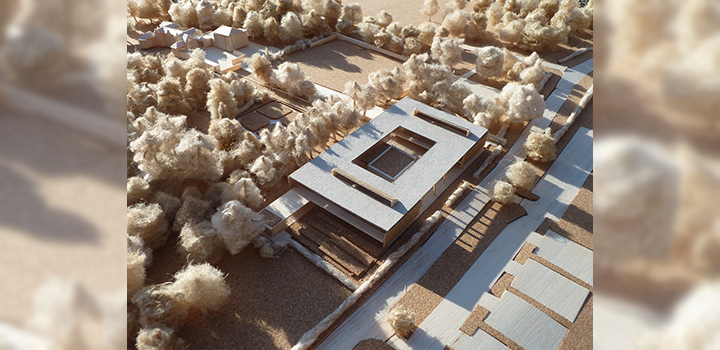
Image: Original design brief image
Stephen Chapman, Director of the Research and Innovation Division at UEA, said: “I’m delighted to mark the 10th anniversary of The Enterprise Centre.
“The extent of the innovations within the construction are testament to UEA’s leading reputation in the area of environmental sustainability and to the architect's and wider project team's foresight and dedication.
“This building is a fantastic example of an on-going legacy around sustainable construction on campus.”
TEC in numbers
50pc natural materials were used as part of its construction (including thatch, flint, straw, oak, and timber from Thetford Forest)
408 square metres of solar panels
65pc lower carbon emissions than a conventionally built Higher Education building
£1.34 Local Multiplier 3 (LM3 score) methodology score (for every £1 invested, £1.34 is reinvested within 25 miles)
99.41pc waste diverted from landfill
26 awards won for its innovative construction methods
100 years – over a 100-year lifespan, TEC’s embodied carbon* is estimated to be just 47pc of the sector average (440 kgCO₂/m² vs 925 kgCO₂/m²)
* Embodied carbon refers to the total greenhouse gas emissions associated with a product's entire lifecycle, from raw material extraction and manufacturing to transportation, use, maintenance, and end-of-life disposal.
Use of local and natural materials
The UK is one of the top three net timber importers in the world, with around two-thirds sourced from Sweden, Finland and Norway. Although there is a source of timber locally, the Corsican pines in Thetford Forest were thought of as of insufficient quality for building, more usually being used for fencing.
However, following rigorous testing by the Building Research Establishment, it was found to provide an excellent, safe and strong building material that could then be used to form the massive wooden structure of the building.
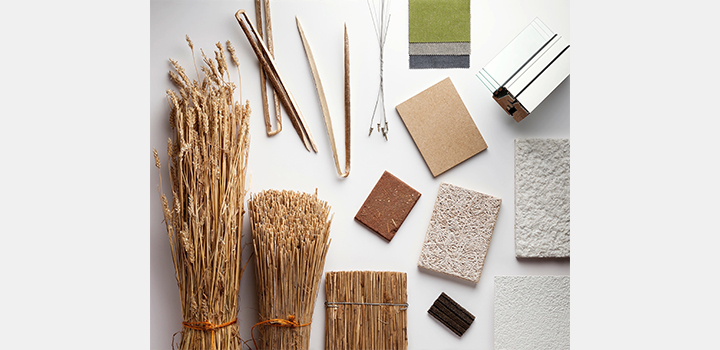
Image: Early design brief image suggesting natural materials to be used
Ben Humphries, Director at Architype, the architects involved with the project, said: “This was a remarkable project to be involved with. Innovative in so many ways, it is great to see that the largely bio-based palette of materials looks so good 10 years on, dispelling the myth that longevity is only achieved with steel and concrete.
“Especially pleasing is the environmental performance. The Enterprise Centre has achieved nine ‘A rated’ display energy certificates in a row, which is a real testament to the effectiveness of the Passivhaus standard to perform as designed.
“Most of all we are delighted that The Enterprise Centre is so well loved by the businesses, students and conference visitors that use the building.”
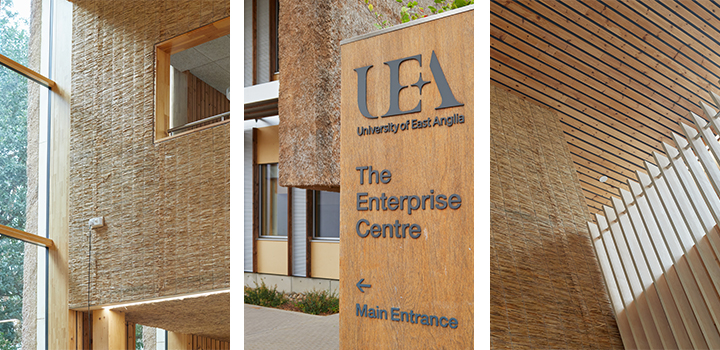
The exterior features ultra-low embodied carbon thatch panels, sourced from local materials and crafted by local artisans. These panels are demountable and replaceable.
Hemp, nettle and clay were used primarily for internal walls and surfaces. These materials were chosen for their low toxicity, sustainability, and aesthetic qualities.

Image: Stephen Letch, Norfolk Master Thatcher, pictured at his barn
A sustainable home for business
Today, the building is home to over to more than175 businesses, primarily start-ups and small and medium enterprises (SMEs), including:
Chadwicks - a wealth management company that counts several UEA graduates amongst its staff and runs their master class programme primarily from TEC.
WeatherQuest - which provides business critical forecasting and data to a range of sectors and businesses, is a UEA spin-out company.
Triple Bottom Line Accounting - which has grown from a two-desk operation, to an eight-person office. The company provides carbon accounting services and guidance to their clients and counts UEA graduates as employees.
Stephen said: “We’re proud to be part of the thriving business ecosystem across the whole of the Norwich Research Park.
“We take our civic responsibility very seriously and are extremely proud of the national Civic Trust Award we received, which recognises the building's inclusive design and the positive contribution it makes to the community.
“As well as continuing to benefit our local community, we are immensely proud that The Enterprise Centre remains internationally recognised as an exemplar.
“Our teams have welcomed countless students and businesses through the front doors over the years, and everyone continues to be enormously impressed by the building.”
Related Articles

OpenAI model halt is responsible move, UEA expert says
Halting the roll out of Open AI’s new model over safety concerns is the “ethical and responsible” thing to do – according to an expert in artificial intelligence at the University of East Anglia.
Read more
UEA places in top 25 in the UK for research quality in prestigious global university rankings
The University of East Anglia has been recognised among the top 25 in the UK for research quality.
Read more
£1.5 million project tackles Britain's workplace health crisis
Fewer late-night emails and greater flexibility at work could help keep millions of people healthier, according to experts at the University of East Anglia.
Read more