'Trade-offs' between wellbeing and resilience
By: Communications

There can be ‘trade-offs’ between increasing human wellbeing and improving the resilience of societies and ecosystems, researchers say.
Wellbeing and resilience to environmental changes are key goals of sustainable development, and they are often seen as linked or even interchangeable terms.
But a new study involving researchers at the University of East Anglia (UEA) says the two don’t always go hand in hand.
This is especially the case if wellbeing and resilience are understood too simplistically – but appreciation of the complex links between the concepts can help to find win-win scenarios.
Prof Laura Camfield, Head of UEA’s School of International Development, said: “Looking at trade-offs through a wellbeing lens was a great opportunity to bring together critical social science with environmental science.
“We built on prior work at UEA on the complex and contextualised nature of wellbeing and resilience. This was a collective endeavour, arising from a writing retreat in Devon where we shared the examples highlighted in the paper to show how these important goals are not always compatible – an important insight for COP26.”
The study, by an international team of researchers and development organisations, was led by the the University of Exeter.
Dr Tomas Chaigneau from the University of Exeter said: “We want to highlight the vital distinctions and connections between wellbeing and resilience ahead of the COP26 UN climate change conference in Glasgow next week so that policies can be better designed and ensure that addressing the climate crisis does not harm people’s wellbeing and livelihoods.
"Wellbeing and resilience both feature heavily in policy targets, especially those relating to sustainable development.
"Assuming that the two automatically go together is not helpful.
"When this mistake is made, it is often the poorest and most marginalised people who suffer.
"For example, after the 2004 Asian tsunami, new legislation in India and Sri Lanka prevented homes and businesses being rebuilt close to the coast, in order to create buffer zones and build resilience to future tsunamis.
"This forced people who depended on the sea for economic, cultural and social reasons to move to isolated villages inland, undermining wellbeing in diverse ways.
"If these trade-offs had been thought through more thoroughly, then measures to ameliorate them could have been implemented alongside them.
"Our website provides an opportunity to explore some of these complex trade-offs."
Dr Chaigneau also said that understanding and pursuing wellbeing in simple economic terms is driving the climate crisis, and therefore undermining resilience in potentially devastating ways.
The research team – which also includes Northumbria University, the Stockholm Resilience Centre, the Global Resilience Partnership and Practical Action – say a more inclusive interpretation of the concepts can lead to better outcomes for people and the planet.
"A narrow focus on achieving resilience and wellbeing locally and in the near future, can lead to trade-offs elsewhere or in the future. We need to consider resilience and wellbeing at regional and global levels, and on timescales spanning generations," Dr Chaigneau said.
"Responding to extremes in hot or cold temperature changes linked to climate change through air conditioning or central heating, for example, might improve human wellbeing and may even enhance our household resilience to such environmental and climatic changes, but in the long term, it can exacerbate climate change and won’t be good for either.
"We need to think of wellbeing and resilience as processes rather than simple outcomes.
"We hope our paper will provide food for thought ahead of the vital COP26 talks."
The paper, published in the journal Nature Sustainability, is entitled: "Reconciling wellbeing and resilience for sustainable development."
Related Articles
UEA academic set to sail from Africa to Australia for UNICEF
Prof Maren Duvendack, an intrepid academic from the School of Global Development at the University of East Anglia, is sailing more than 8,000 km from South Africa to Australia to raise money for UNICEF.
Read more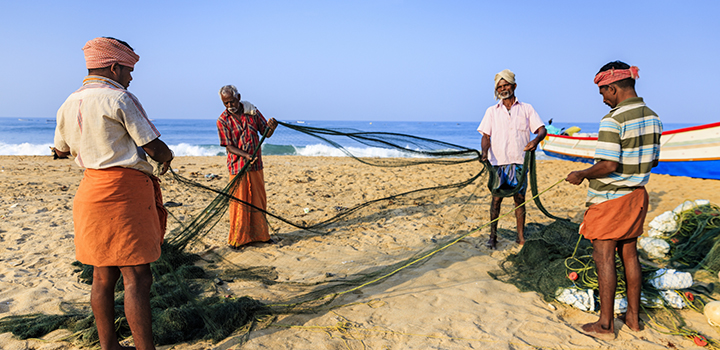
Family networks improve outcomes for internal migration
Small-scale fishers in India could be benefiting from increase in forced migration, thanks to new research from UEA.
Read more
New report from UEA Academic asks whether UK Aid Match has been used for ‘charity washing’, ahead of Westminster event
A new report from the University of East Anglias Dr Martin Scott into the Governments UK Aid Match (UKAM) scheme has led to concerns of charity washing, with suggestions some UKAM allocations may reflect Ministers pursuit of reputational benefits, rather
Read more